

Future Paramedics at TNMU Practise Their Skills at TESIMED
Under the patronage of Arsen Hudуma, Professor and Head of the Department of Emergency and Simulation Medicine, the Student Scientific Society continued its work at the TNMU Simulation Training Centre (TESIMED) during the 2026–2027 academic year. Its main aim is to deepen students’ theoretical knowledge and develop practical skills related to prehospital and emergency medical care. Meetings are held every Wednesday after the fourth class at the TNMU Simulation Training Centre. Students enrolled in the Paramedic educational and professional programme have been particularly active in recent meetings.
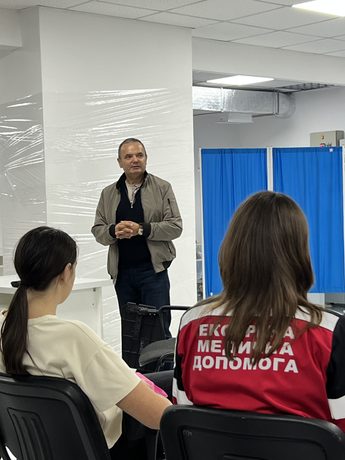
The first meeting, held on 9 September, focused on the fundamentals of ECG recording and interpretation. Under the guidance of Antonina Chervatiuk, Head of the Simulation Training Centre and Assistant Professor of the Department of Emergency and Simulation Medicine, the students thoroughly reviewed the heart’s conduction system, the principles underlying the representation of ECG waves, and methods for determining the electrical axis of the heart. They immediately consolidated their knowledge in practice by examining and analysing a series of electrocardiograms.
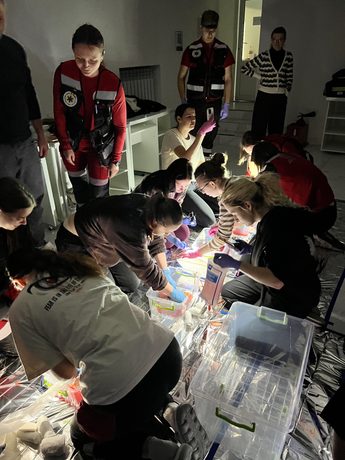
The topic of the 23 September meeting, “Wound Packing: Techniques, Materials and Challenging Cases”, generated even greater interest. The students understand that wound packing, although seemingly a basic first-aid skill, requires regular practice to ensure that life-threatening bleeding can be controlled quickly and effectively in critical situations.
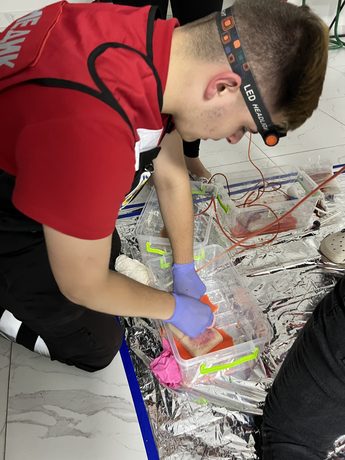
This session was led by Yurii Denysiuk, Associate Professor of the Department of Emergency and Simulation Medicine. First, the students reviewed the wound-packing algorithm and the principles of action of haemostatic agents. They then practised packing gunshot, shrapnel and laceration wounds using specialised simulators that delivered artificial blood under pressure. To make the training more challenging, the paramedics also had to work in darkness and in the presence of distracting background noise.
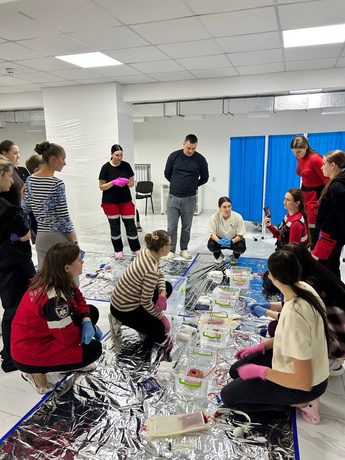
The culmination of the session was a scenario in which students had to provide prehospital and emergency medical care to a simulated casualty injured in an explosion. The realistic appearance of the injuries, darkness, the sound of a wailing siren, and the emotional pressure created by witnesses tested not only the students’ knowledge and practical skills but also their ability to remain resilient under stress. The students practised interacting effectively with everyone at the scene in order to save the casualty’s life and protect their health.
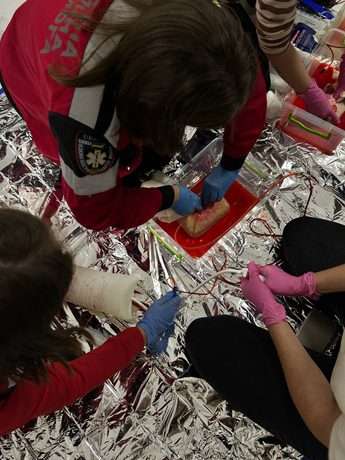
After the scenario, Yurii Denysiuk conducted a debriefing that enabled the participants to analyse their actions and observations, identify successful decisions, and highlight aspects requiring greater attention in the future. According to the students, the two-hour session passed in what seemed like a moment.
The participants and organisers succeeded in creating an environment where difficult tasks become manageable, while seemingly simple skills reveal their complexity. Most importantly, the simulation centre provides a safe space where students can make mistakes and learn from them — helping to prevent as many errors as possible in their future work with real casualties.