

TNMU Paramedic Students Mastered Water Rescue Skills
Helping people on the water is one of the challenges facing emergency medical teams. The large number of sports facilities, recreation and health centres that use the water pool pose a constant danger to visitors, especially if it is not handled properly and there are no trained rescue swimmers on the scene.
In modern conditions, university students have the right to make proposals regarding additional educational components that will shape their individual educational pathway and contribute to a better entry into the profession.
TNMU 3rd-year-paramedic students suggesting the course aimed at mastering key skills of rescue in case of drowning, especially at the first stage – approaching the person in shallow water, in particular in the pool, assessing their condition, moving to the edge of the pool, removing them from the water and then providing complex of emergency medical care.
The students’ proposal was considered at a meeting of the Department of Emergency and Simulation Medicine of TNMU with the participation of teachers of the Department of Physical Therapy, Occupational Therapy and Physical Education, where a decision was made to organize a practical lesson on water rescue skills in the context of their future professional activities.
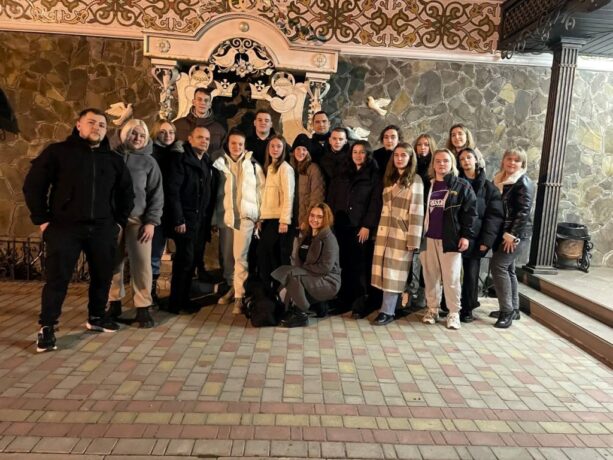
On February 12, 2024, in the swimming pool of the Orysia hotel and wellness centre in Chortkiv district, TNMU paramedic students underwent training on practicing key skills in water rescue. The classes were conducted by the Head of the Department of Emergency and Simulation Medicine, Professor Arsen Hudyma, Assistant Professor of the Department Nargiz Dzavadova, Associate Professor of the Department of Physical Therapy, Occupational Therapy and Physical Education Viktor Nazaruk – a professional swimmer and a 2nd-year Master’s student majoring in “Physical Therapy, Occupational Therapy”, professional swimmer Bohdana Danyliuk, who performed the mission of a standardized patient.
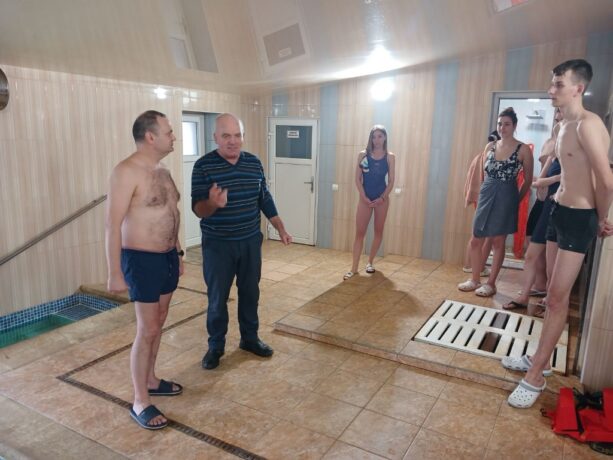
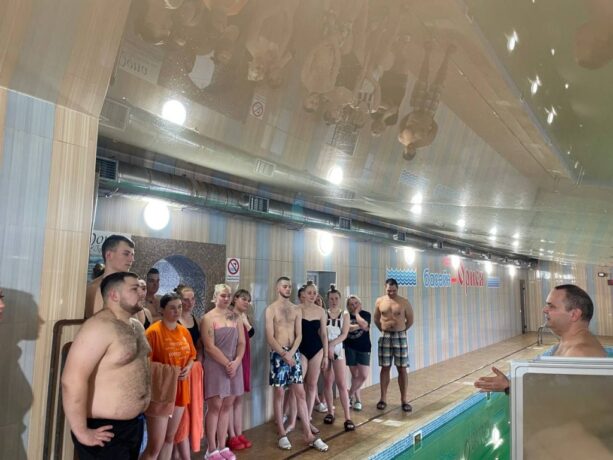
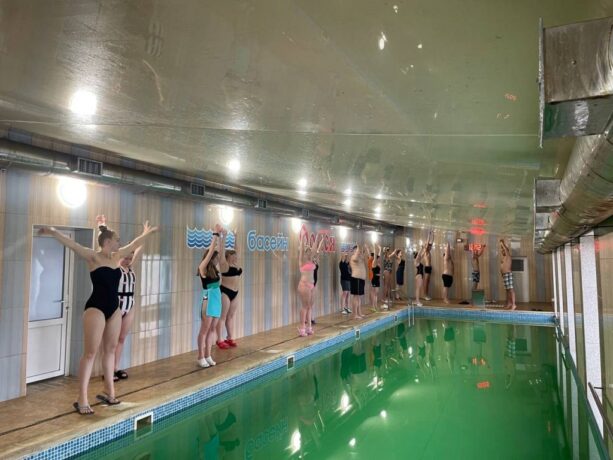
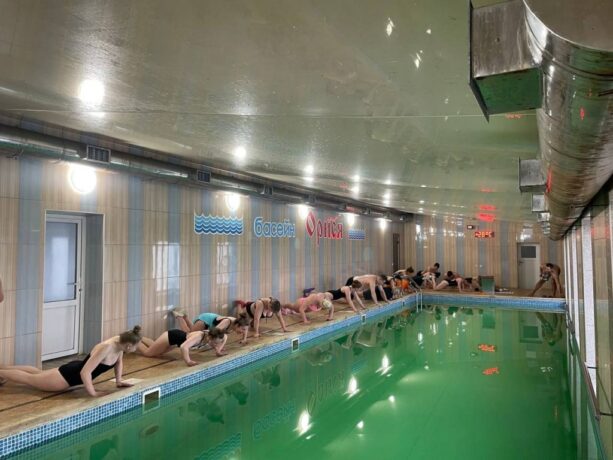
At the beginning of the lesson, Professor Arsen Gudyma introduced the lesson plan and emphasized the practical skills and abilities that students will acquire during the practical class. After that, Associate Professor Victor Nazaruk together with Bohdana Danyliuk conducted a warm-up and adapted the students to work in water.
The first skill that young people mastered was recognizing a victim who is drowning and is in a state of stress, chaotically moving their limbs, asking for help. It was emphasized that such a person can become a real drowner and be in a state of active drowning (making every effort to keep the face above the surface of the water) or passive drowning, when the face is completely submerged in water. Bohdana Danyliuk was a demonstrator of various variants of the drowning person behaviour.
The next skill was to practice entering the water. Since the height of the side of the pool did not exceed 25 cm, and the depth was within 150-160 cm, the students learned to enter the water using the “wide step” method.
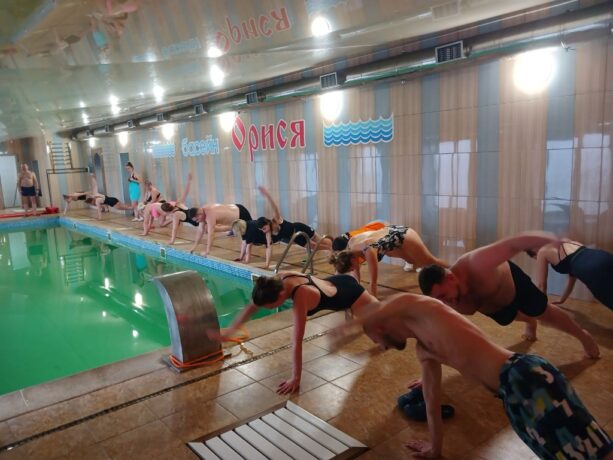
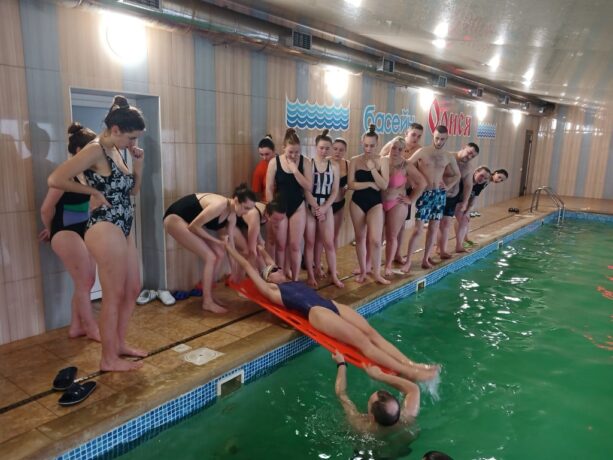
The next step was approaching the drowning person in active drowning, communication. According to the legend, a drowning person grabs a rescuer’s torso, creating an additional threat to their life. The students were taught how to free themselves from this grip and move the drowning person to the edge of the pool either in a supine or stomach position.
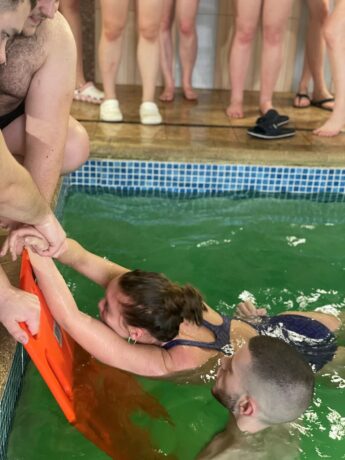
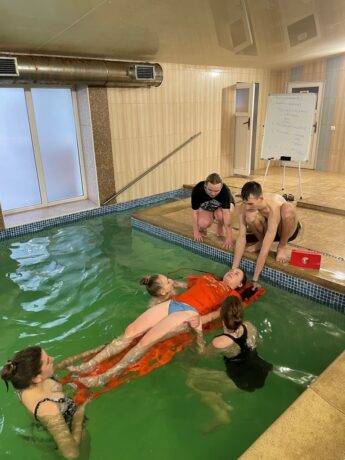
The next step is to lift the victim out of the water using a long transport board. Teams of 3 people worked: two on the edge of the pool, who put a board into the water, grabbed the victim by the hands and lifted them on board. A third person in the water corrected this process, assisted in placing the victim on the board and getting them out of water. This skill is useful in the event of a sudden deterioration in the drowning person’s health, not related to trauma, or in the event of significant fatigue.
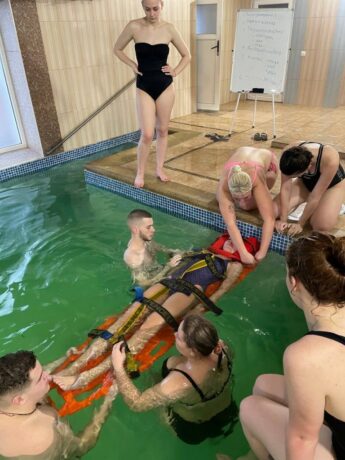
In the event of an injury (jumping into shallow water with the head down, careless handling, etc.), it is necessary to move the victim face up with simultaneous protection of the head and neck. Students were taught to turn the victim from a face-down position to a face-up position using the victim’s arms as a means of immobilizing the head and neck. In the case of a visible injury of the upper limbs, manual fixation of the head and neck by the rescuer was demonstrated, including and turning the victim from a face-down position to a face-up position. Next – transportation to the edge of the pool and fixation on a long transportation board using a head holder and fixation straps. The next step is to lift the victim on the border of the pool.
Each team of three students practiced the above emergency scenarios. In the course of work, the teachers Arsen Hudyma and Nargiz Dzavadova corrected the students’ activities. Viktor Nazaruk monitored general discipline and ensured control of safety on water.
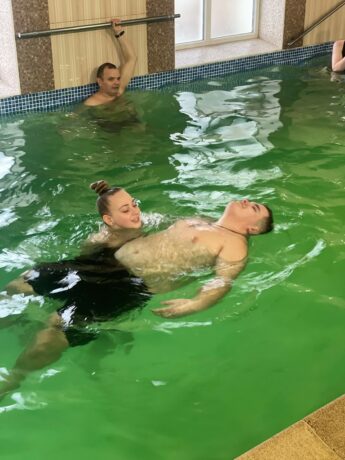
At the request of the students, they additionally practiced the skill of rescuing a person with a large body weight on water.
At the end of the class, there was a general debriefing, where each student was able to say what they managed to do well, and what they would have done better during repeated practice.
Teachers also received feedback from the students, during which they highly appreciated the lesson and wished to increase the time for practicing skills in water and further full practice of the algorithm of saving a drowning person with cardiopulmonary resuscitation or providing assistance to a critically injured patient by an emergency medical aid team and transportation to a medical facility (taking into account the specifics – wet, injured, having been in water for some time, etc.). Indeed, there is an opportunity to improve this activity. The university has a fully equipped resuscitation vehicle, means for simulation training, so the next time it will be a water rescue together with full-fledged resuscitation of the victim and transportation to a medical institution.
In the remaining time, the students had the opportunity to get better in the hydromassage bath with Husiatyn brine, warm up in the sauna. Those who could not swim received their first professional swimming lessons. This, perhaps, is the advantage of the Orysia hotel and wellness centre, where you can combine the useful with the pleasant.
We express our appreciation to Yaroslav Uhliar, the director and owner of the “Orysia” hotel and wellness centre, who always responds positively to any educational and wellness initiatives and puts a lot of personal effort into their implementation.
The information was provided by Professor Arsen Hudyma.
Photographs by the organizers of the event.