

Visit of Experts from the International Commission on Missing Persons (ICMP) to the Educational and Scientific Institute of Morphology of TNMU
The Russian military aggression and numerous war crimes against the Ukrainian military and civilian population have prompted our country to seek assistance from various international organizations to investigate these crimes, as well as to locate, trace, and identify missing persons. Currently, around 70,000 people in Ukraine are considered missing. The only international organization that deals exclusively with the issue of missing persons is the International Commission on Missing Persons (ICMP), headquartered in The Hague, the Netherlands.
The ICMP was established in 1996 as an intergovernmental organization addressing the problem of missing persons resulting from armed conflicts, human rights violations, and natural disasters. Its mission is to assist governments in exhuming mass graves and identifying missing individuals. The DNA identification system developed by ICMP has become an international standard in human identification. The organization’s laboratories conduct complex DNA analyses based on skeletal remains of missing individuals.
On October 9, 2025, a group of ICMP experts visited the Educational and Scientific Institute of Morphology at Ternopil National Medical University. The delegation was led by Dr. Soren Blau, Head of the Department of Forensic Archaeology and Anthropology at ICMP. Dr. Blau joined the organization in June 2023, after 18 years of work as a senior forensic anthropologist and head of the Identification Service at the Victorian Institute of Forensic Medicine (VIFM) in Melbourne, Australia. She also serves as a consultant for various governmental and non-governmental organizations, including the International Criminal Court (ICC).
The group also included another world-renowned forensic anthropologist and archaeologist — Gaille MacKinnon from Scotland, a leading British expert in the field and a member of the same ICMP department. Gaille participated in the identification of victims following the 2010 Haiti earthquake and the 2001 World Trade Center terrorist attack. Ukrainian ICMP experts included Dr. Daria Cherkaska, a forensic archaeologist and anthropologist, and forensic medical experts Petro Bobkov and Olha Nechyporenko.
During the visit, guests were given a brief overview of the history, development, and achievements of TNMU as one of Ukraine’s leading medical universities.
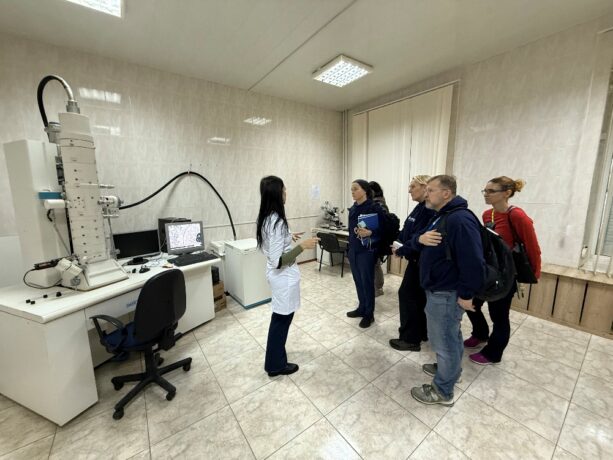
At the Department of Histology and Embryology, the visitors were welcomed by senior lecturer Violetta Kulbitska, who invited them to tour the department’s classrooms and the electron microscopy laboratory. She spoke about the subjects taught, the structure of practical training, and the principles of working with an electron microscope.
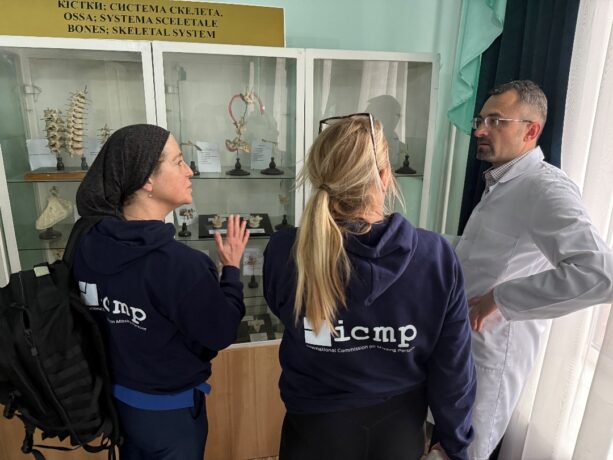
At the Department of Human Anatomy, Associate Professor Borys Reminetskyi guided the guests through the Anatomical Museum, demonstrating the possibilities of using modern interactive 3D programs for studying human anatomy.
A key part of the ICMP experts’ visit to the Institute of Morphology was the tour of the Department of Pathological Anatomy with a Sectional Course and Forensic Medicine, since the department’s faculty members conduct various types of forensic examinations upon request from law enforcement agencies. Their practical and clinical work is closely related to the professional interests of the ICMP representatives.
Professor Valentyn Franchuk, Head of the Forensic Medicine Course, presented to the guests the organizational structure and principles of Ukraine’s forensic expert service, as well as the department’s major achievements in both forensic science and expert practice.
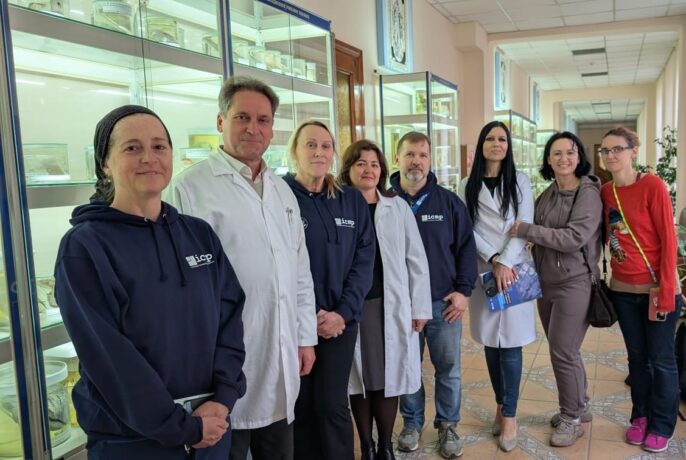
The ICMP experts also showed great interest in the methods of teaching forensic medicine at TNMU, as Dr. Soren Blau and Gaille MacKinnon themselves have extensive teaching experience in forensic medicine, criminology, and forensic anthropology at leading universities in the United Kingdom. The distinguished guests were particularly impressed by the Pathological Anatomy and Forensic Medicine Museum, which houses one of the richest collections among all medical universities in Ukraine.
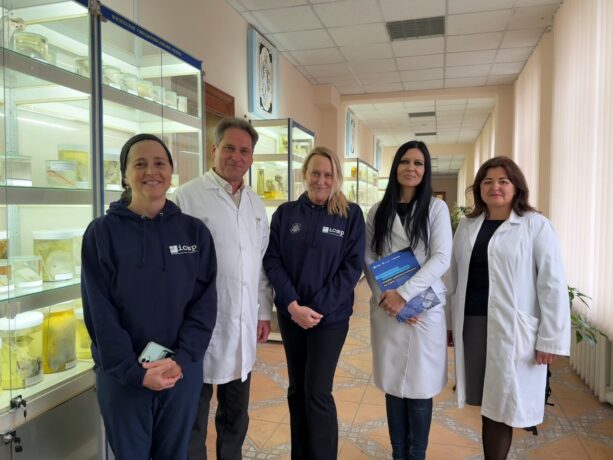
At the end of the visit, the faculty of the Department of Pathological Anatomy, with a Sectional Course and Forensic Medicine, organized a sightseeing tour of the city for the guests. The ICMP experts expressed sincere gratitude for the warm hospitality, meaningful discussions, and friendly atmosphere during their visit. They also voiced hope for continued communication and the development of scientific cooperation in the field of forensic expertise.