


Dmytro Zabolotnyi: “War-Related Otolaryngological Injuries Rank Second in Prevalence”
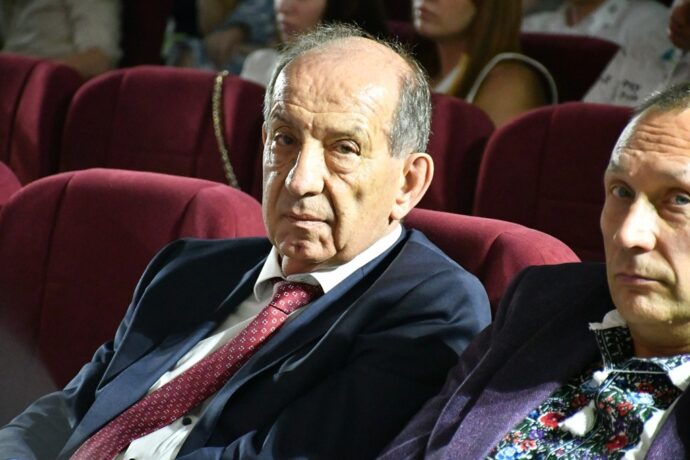
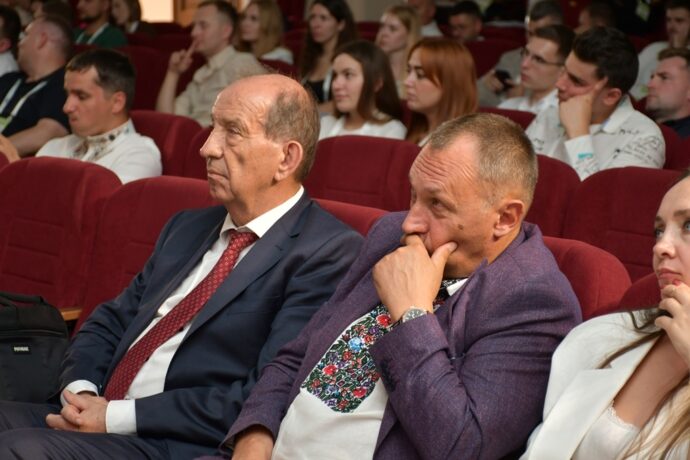
The conversation with Professor, Academician of the National Academy of Medical Sciences of Ukraine (NAMS), member of the Presidium of the National Academy of Medical Sciences of Ukraine, and Director of the State Institution “O. Kolomiichenko Institute of Otolaryngology” Dmytro Zabolotnyi took place during his visit to Ternopil and Ternopil National Medical University, where he participated in a charitable otolaryngology symposium. Dmytro Illich is an honorary professor at TNMU. He noted the high level of specialists at the Department of Otolaryngology, Ophthalmology, and Neurosurgery of our university and added that it is the only department in Western Ukraine where ear surgeries are performed. According to the academician, war-related otolaryngological injuries rank second in prevalence.
— Why do otolaryngological injuries rank second?
— All explosions, whether direct or from blast waves, cause ear injuries. Primarily, the eardrum suffers. It must be restored so a person can hear properly and live a full life. I came to Ternopil for the conference, and I want to point out that many doctors attended this professional event. There are nearly three hundred otolaryngologists from various regions of our country. I would say that the Ternopil charitable otolaryngology symposium is in no way inferior to national conferences held in Kyiv. Attendees could observe live surgeries via direct broadcast from the operating room and hear substantial presentations. And in Ternopil, ear surgeries are performed at a high level.
— How is the field developing today?
— It should be noted that otolaryngology in Ukraine is so advanced and modern that we perform almost all the surgeries done in the EU and other countries. Leading specialists from Europe and the USA have come to us with various master classes and workshops, and our specialists have trained in European and American clinics. The only area where we lag behind is robotics. Ukraine has been an independent state since 1991, and since then we have not sent a single patient with otolaryngological pathologies abroad for treatment. Our field includes many surgeries that determine a patient’s health and quality of life. Moreover, most surgeries are performed endoscopically. Abroad, for example, only 10–15% of throat surgeries are performed transorally, and the rest through external access. In Ukraine, 70% are performed endoscopically. Young specialists frequently travel abroad to exchange experience, grow professionally, and master new innovations. At our Institute, we have a linear accelerator that allows us to effectively treat oncological otolaryngological diseases.
— You say young specialists strive for development. Does this mean otolaryngology has a worthy younger generation?
— Many young specialists choose otolaryngology. There are many young professionals in clinical practice. The only area where young people do not go is science. This is because scientific salaries are quite low. For example, a professor at a research institute earns 9–11 thousand UAH. I hope this issue will eventually be resolved in our country.
— The Institute of Otolaryngology has positive experience treating patients with hearing loss…
— We thoroughly study and treat middle ear pathologies; for instance, we closely collaborate with Kyiv Polytechnic Institute. Many congenital abnormalities also require surgery and specialized treatment. For many years, we have been working to restore hearing in people who are hard of hearing or deaf. Today, new technologies help solve this problem. Regardless of age, we implant an artificial ear — an implant — and place a hearing device externally. Imagine that if a child with hearing loss stays with us for a week, they begin to hear. But afterward, a year of work is needed so they learn to speak and process sounds. We began this work back in 1990. Previously, the waiting list for an artificial ear implant was 1–2 years, but today there is no such queue. All children who come to us undergo surgery and receive an implant in a short time. Only a small percentage of children are not eligible for this procedure.
We perform the same surgeries for soldiers. Besides eardrum injuries from blast trauma, the auditory nerve is often damaged. Such patients lose hearing. We also implant an artificial ear for them and restore hearing. They do not need additional speech training, since before their injury they could speak and process sounds.
I want to say that today the state provides proper support so that everyone who needs such an implant can receive one. Typically, 90% of our patients are children and 10% are adults. Every five years, the external hearing device must be replaced as its lifespan ends. This is also done at our Institute. We check hearing, provide a new device — and people live full lives.
It is difficult to convey the emotions of parents and ours when a child who has not heard for a long time begins to hear after surgery. Parents invest a great deal in these children. We rejoice in our patients’ successes — among them are champions of Ukraine and the world in various sports, music, etc.
— The Institute also had a phoniatrics department for many years. Has this direction been preserved?
— This field is highly developed, since deputies, singers, teachers, and lecturers all require phoniatric care due to vocational strain on their vocal cords. These patients often have small benign tumors that we surgically remove, as well as functional disorders. Our phoniatric specialists work with them. In the mornings, on the 6th floor of our Institute, you can hear singing — our specialists select appropriate compositions to make patients’ vocal cords work as needed. Almost all artists have been treated with us, except for Dmytro Hnatyuk. He once said that a cantor in his village taught him to drink specific herbal infusions in case of voice loss. Today, many common pathologies are well treated in private clinics, and we receive the more complex cases. The O. Kolomiichenko Institute of Otolaryngology accepts all patients for treatment — the main requirement is a referral from a doctor. We refuse no one and we have adequate resources.
Reference:
Dmytro Zabolotnyi has made a significant contribution to the development of cochlear implantation technology for the rehabilitation of patients with deafness, as well as to the study of immunity in patients with inflammatory diseases of the upper respiratory tract.