

TNMU Hosted the Training “Physiological Foundations of Health and the Role of Creative Writing in Reducing Everyday Stress”
On December 18, 2025, TNMU faculty members gathered in the reading hall of the TNMU Library for a training session aimed at reducing everyday stress.
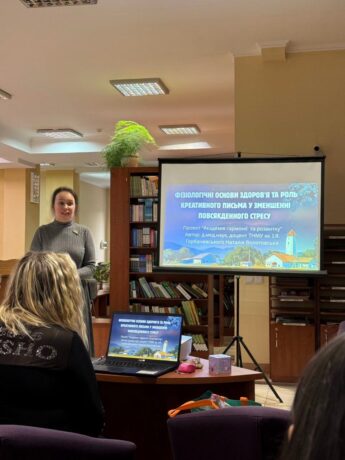
The event was held within the framework of TNMU’s professional development plan for academic staff and was conducted by Nataliia Volotovska, MD, PhD, Associate Professor of the Department of Physiology with Bioethics.
The training began with outlining the foundations of a successful educational process, including academic performance, university rankings, and teaching workload. Ms. Volotovska shared experience gained through participation in national and international training programs devoted to the psychology of creativity, art coaching for adults and children, and stress management under conditions of full-scale invasion. She emphasized that greater team cohesion emerges from understanding that behind indices and performance indicators there are always real people—with their fatigue, emotional and physical resources, high work motivation, or, conversely, inner resistance that most often arises when one’s own psychosomatic manifestations are continuously ignored. This can be prevented by allowing oneself to experience both anger and fear and by classifying them not as negative but as positive emotions. Particularly important are the next steps—transforming these emotions into appropriate physical action or into art therapy, including the written word. From a physiological perspective, the explanation proved to be quite simple: an emotion that has been fully experienced will not turn into a symptom.
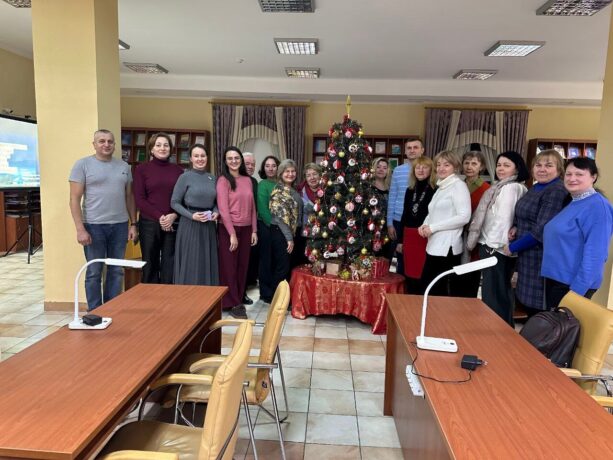
Participants actively engaged in the exercises, which reflected the metaphorical nature of their life experiences. Especially interesting was observing their own bodily responses, noted by all attendees after listening to an author’s meditation by Nataliia Volotovska. It demonstrated the key outcome—the activity of the sympathetic nervous system decreased, resulting in a calming effect. Equally important was the moment of live interaction, where sincere smiles and hugs, even if only briefly, provided greater emotional support for each participant.
Such events contribute not only to maintaining motivation and work capacity but also to fostering a culture of self-care in conditions of high intellectual and scientific workload. The experience of this training confirmed the importance of integrating scientific knowledge, creative practices, and live interaction as key factors in the sustainable development of a modern university environment.