

Students of the “Paramedic” Educational and Professional Program Improve Their Water Rescue Skills
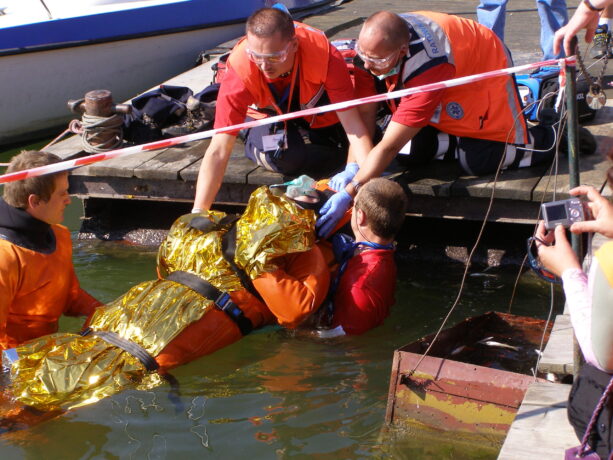
Paramedics often face situations during emergency calls where they need to provide urgent medical care to victims in water—whether at a swimming pool or along the shore of a body of water. But what should be done when the victim is still in the water and the environment appears relatively safe? What if the person has a head, neck, or spinal injury, where untrained rescue attempts by bystanders could cause further harm? A similar scenario was one of the competition tasks at the International Summer Championship of Emergency Medical Care in Poland in 2006.
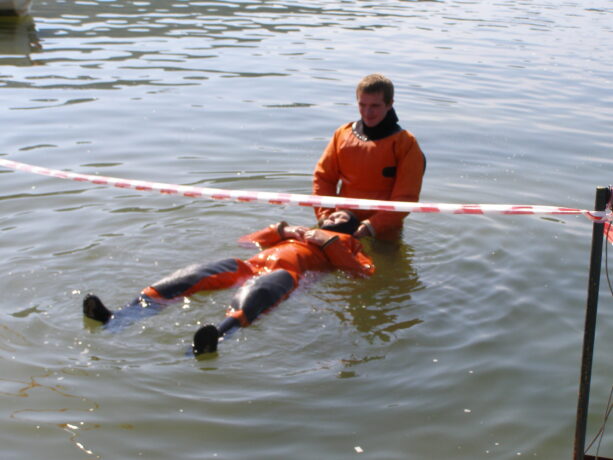
These issues were addressed during traditional training sessions for third-year paramedic students. The training was organized by the departments of Emergency and Simulation Medicine, Physical Therapy, Occupational Therapy, and Physical Education, as well as specialists from the Simulation Training Center (TESIMED). The sessions took place in the swimming pool of the “Orysia” hotel and wellness complex in the village of Oryshkivtsi, Chortkiv district, with the support of the owner and director, Yaroslav Uhliar.
The training began with a warm-up, adaptation of participants to the water, and demonstrations of different swimming styles that illustrate a person who feels confident in the water. This part was led by Associate Professor Viktor Nazaruk and third-year medical student and swimmer Uliana Poberezhnyk.
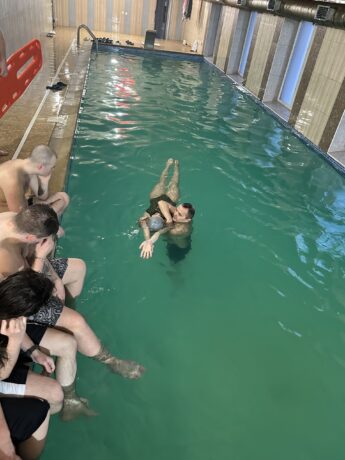
The next step involved recognizing a person experiencing difficulties in the water. Uliana demonstrated various types of distressed swimmers: a swimmer in trouble, an active drowning victim, and a passive drowning victim.
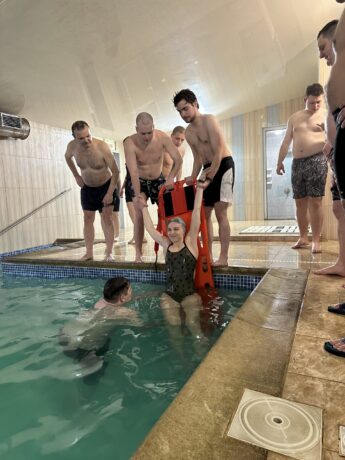
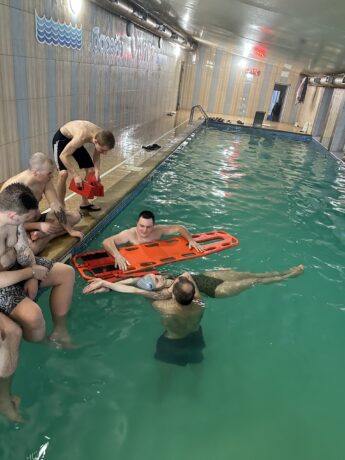
After that, under the guidance of Professor Arsen Hudyma, Associate Professor Yurii Denysiuk, and simulation center specialists Oleh Kosinskyi and Valerii Zhyzhnomirskyi, students practiced safe approaches to a conscious drowning victim, transportation to the pool edge, and lifting the victim out of the water using a spinal board. According to the scenario, the victim was unconscious with a suspected head, neck, or spinal injury and was face down in the water. Students practiced techniques for stabilizing the head and neck, turning the victim face up, maintaining alignment of the head, neck, and torso, transporting to the pool edge, securing the victim on a spinal board, and lifting them out of the water.
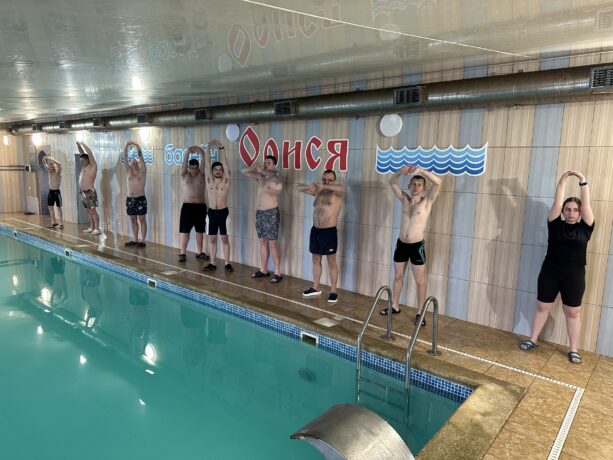
Divided into four subgroups, the future paramedics practiced all rescue procedures in turns. Initially, Uliana Poberezhnyk played the role of the victim, after which students tested their skills on classmates weighing around 100 kg. Everyone concluded that when proper technique is applied, the victim’s weight is not a critical factor. Some concerns were also raised about Chinese medical equipment, which proved not entirely suitable for use in water.
The training allowed all participants to work as one team and experience the therapeutic facilities of the “Orysia” complex, including hydromassage baths with Husyatyn brine (enhanced with Poltava bischofite), a sauna, hammam, and hot tub. Participants also improved their swimming skills.
Yaroslav Uhliar spoke about the history of the “Orysia” complex and its core concept of hydrotherapy, which aligns with the system developed by the German priest Sebastian Kneipp. He emphasized that the main highlight of the complex is the Husyatyn brine—a remnant of an ancient sea, extracted from a depth of 720 meters, known for its exceptional purity and rich content of trace elements that are absorbed by the body during hydromassage treatments.
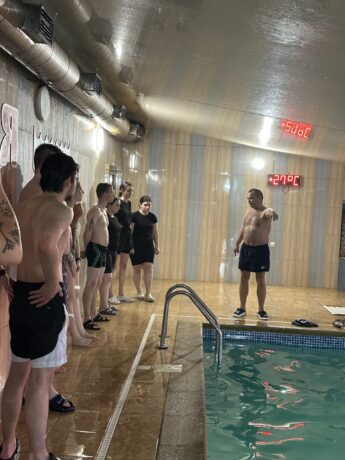
Lecturers and students of Ternopil National Medical University express their gratitude to the university administration for organizing the opportunity to practice essential skills in a real environment, as well as to the university bus driver, Yaroslav Kulchytskyi, for ensuring safe transportation.