

Awareness-Raising Activities on Digital Transformation within the “Digi-CHange” Project
From April 23 to May 5, 2026, a series of open lectures, seminars, and webinars was held at I. Horbachevsky Ternopil National Medical University to disseminate information about the project 101233888 ERASMUS-EDU-2025-CBHE Partnerships for Transformation in Higher Education “Digi-CHange” (“Digital Transformation and Curriculum Development for Healthcare Teams”), implemented under the Erasmus+ KA2 program.
The Erasmus+ Capacity Building in Higher Education project “Digi-CHange” – “Digital Transformation and Curriculum Development for Healthcare Teams” has officially entered its implementation phase, marking an important step toward modernizing medical and nursing education through digital health, artificial intelligence, and interdisciplinary collaboration.
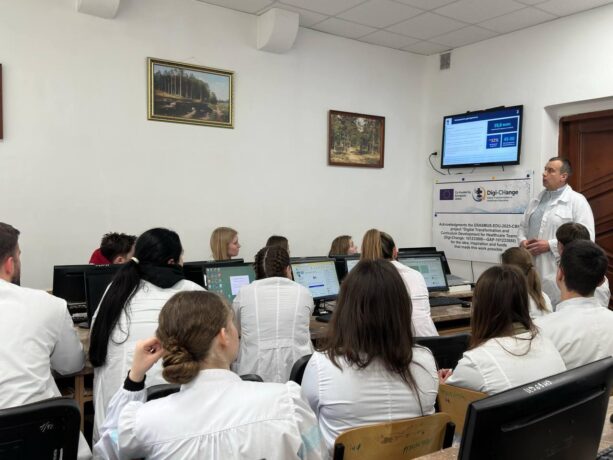
On April 23, 2026, Professor Dmytro Vakulenko, Head of the Department of Medical Informatics, delivered an open lecture for first-year medical students entitled “Artificial Intelligence in Medicine. Telemedicine.” The lecture focused on modern digital technologies actively being integrated into healthcare. During the session, the potential applications of artificial intelligence algorithms for laboratory data analysis, disease risk prediction, and clinical decision support were discussed. Particular attention was paid to the use of telemedicine technologies for remote consultations, patient monitoring, and the transfer of clinical information. Students were introduced to the principles of working with large datasets, their statistical processing, and the critical evaluation of results. The lecture also addressed electronic medical record management and the integration of digital services into everyday medical practice. Special emphasis was placed on the legal and ethical aspects of AI use, particularly the protection of patients’ personal data. The lecture provided students with a broad understanding of how innovative digital tools can be applied in medical practice..
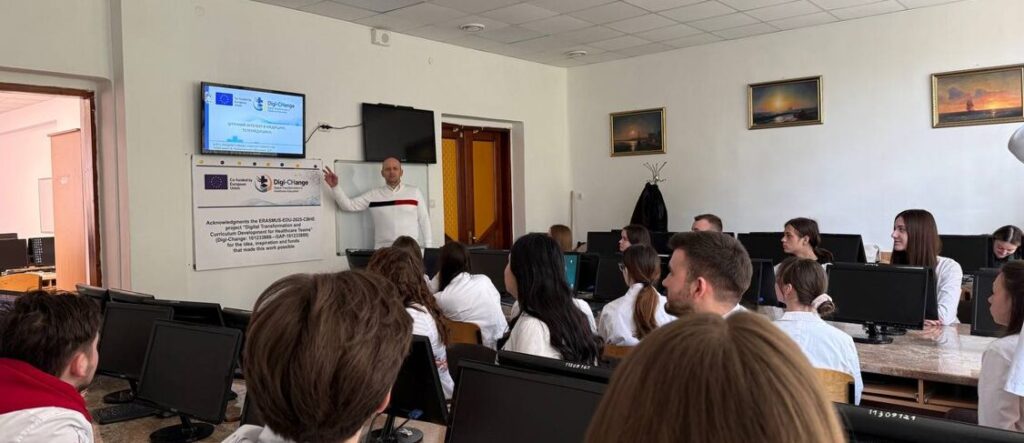
On April 27, 2026, Professor Andrii Sverstiuk, coordinator of the Digi-CHange project and professor at the Department of Medical Informatics, delivered an open lecture for sixth-year medical students entitled “Intelligent Analysis of Biosignals.” The lecture highlighted opportunities for digitalization in higher medical education through the implementation of modern information technologies, data analysis models, and intelligent decision-support systems in the diagnosis of cardiovascular diseases. The use of digital platforms for clinical process modeling, biomedical signal analysis, and the development of practical competencies among students was proposed. The application of artificial intelligence algorithms and automated assessment systems contributes to the personalization of the educational process, enhances the accuracy of knowledge evaluation, and promotes the development of clinical reasoning among future physicians. The findings confirm that digital technologies are an essential factor in modernizing medical education, improving its quality, accessibility, and alignment with current healthcare demands.
On April 30, 2026, a seminar “Research and Analysis of Histological Images (Using Gastric Mucosal Biopsies in Inflammatory Conditions as an Example) to Enhance Digital Literacy among Medical Students” was held in the Laboratory of Immunohistological and Immunocytological Research at TNMU for third-year medical students. The speakers included Professor Petro Selskyi, Head of the Department of Pathological Anatomy with Autopsy Course and Forensic Medicine, associate professors Yurii Orel and Anatolii Slyva from the same department, and Professor Andrii Sverstiuk from the Department of Medical Informatics.
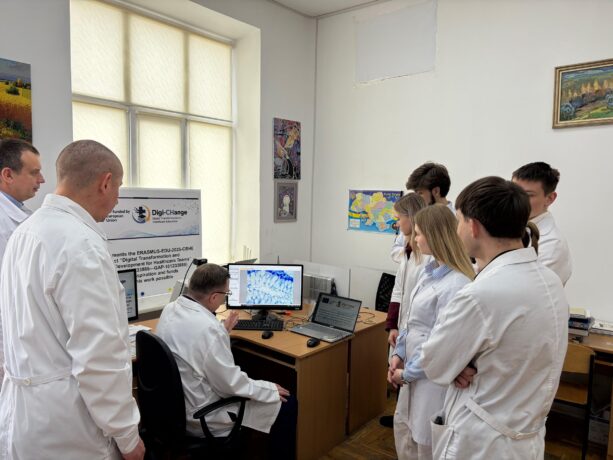
Faculty members from the Department of Pathological Anatomy discussed the specific features of researching and analyzing medical images using gastric biopsies from patients with chronic inflammatory conditions. In particular, they demonstrated the assessment of Helicobacter pylori colonization in different regions of the stomach using micropreparations stained with the Romanowsky–Giemsa method at ×1000 magnification. A Nikon Y-TV55 microscope (Japan) was used for the study.
Professor Andrii Sverstiuk emphasized that within the framework of the Digi-CHange project, the university plans to purchase an OCUS40 Digital Microscope Scanner (Finland), which will be used in the educational process to improve students’ digital competencies in medical image analysis.
The use of the digital slide scanner will enable students to develop practical skills in obtaining highly detailed digital images of histological specimens and utilizing open-access archives while studying courses such as Pathomorphology, Biopsy Diagnostics, and Medical Informatics. The seminar also explored the potential of artificial intelligence algorithms for medical image analysis to predict disease complications and support clinical decision-making.
To further disseminate information about the Digi-CHange project, a webinar entitled “Artificial Intelligence and Telemedicine as Tools for Developing Clinical Reasoning in Surgical Education” was held on May 4, 2026, at the Department of General Surgery. The webinar was conducted by Associate Professor Andrii Hospodarskyi and Professor Andrii Sverstiuk for fifth-year medical students.
During the event, a promising model for integrating artificial intelligence and telemedicine technologies into the educational process was presented, with implementation planned for future stages of the project.
The proposed educational model combines real clinical practice, digital technologies, and students’ collaborative analytical work. The learning process follows a sequential clinical reasoning cycle, beginning with the student independently conducting a comprehensive patient examination, including history taking, symptom assessment, and physical examination.
The collected clinical data will be processed using the AI service TAYRA, which will automate the generation of a structured clinical summary and organize information in accordance with modern international standards.
The resulting digital clinical report will serve as the basis for subsequent group case discussions. Other students, without involving the original examiner, will independently analyze the clinical case, formulate a preliminary diagnosis, identify differential diagnostic pathways, and develop a telemedicine consultation algorithm.
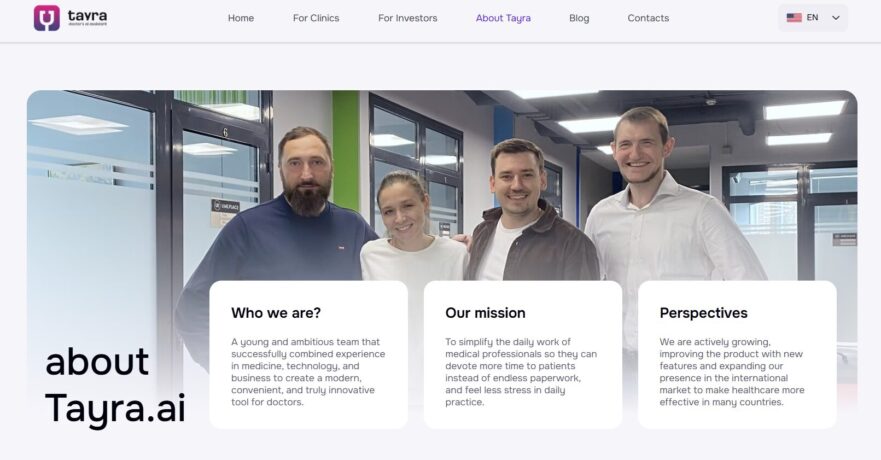
This approach is designed to enhance clinical reasoning, interdisciplinary communication, and proficiency in using digital medical platforms.
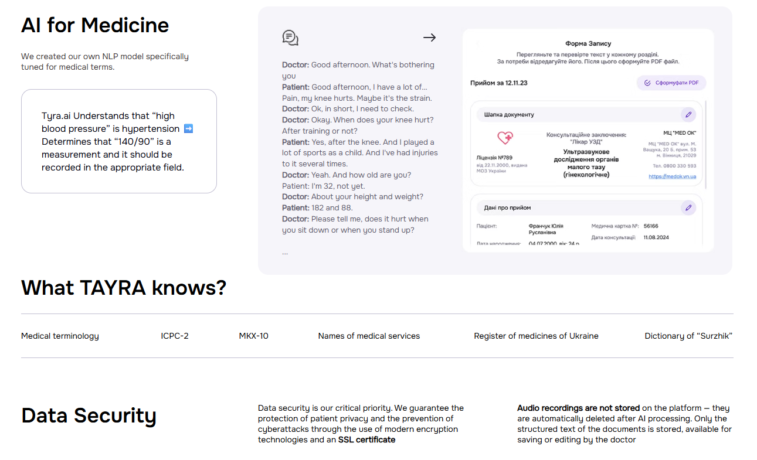
The next stage of the model involves active use of AI tools during ongoing patient management. Through specially designed prompts, students will be able to transform clinical information into professional reports based on the internationally recognized SBAR protocol, widely used in modern clinical practice and telemedicine. In addition, the AI system will generate lists of alternative diagnoses, suggest necessary additional examinations, and help simulate atypical clinical scenarios. During discussions, instructors will act as moderators, emphasizing diagnostic logic, error analysis, and clinical decision-making.
It is expected that implementing this educational model will improve the quality of practical training, foster digital competencies among future physicians, and adapt the educational process to the modern challenges of healthcare. The combination of artificial intelligence, telemedicine, and simulated clinical consultations will create an interactive learning environment focused on developing clinical reasoning, communication skills, and the ability to work effectively in the context of digital healthcare transformation.
On May 5, 2026, within the Digi-CHange project, young researchers presented their scientific achievements. Fifth-year students Sofiia Berehuliak and Mariia Solomakhina, active members of the Department of Medical Informatics and Department of General Surgery student research groups and the TNMU Student Scientific Society, presented the results of their work in the field of pathomorphological diagnostics.
Under the supervision of Professor Andrii Sverstiuk and Associate Professor Andrii Hospodarskyi, they demonstrated the use of modern digital tools in processing complex medical data. Their research focused on the differential diagnosis of ulcerative colitis and Crohn’s disease in general surgery practice. These diseases often present with similar clinical manifestations, creating diagnostic challenges for emergency surgeons.
A major challenge for the students was the absence of standardized terminology in pathomorphological reports following endoscopic examinations. Manually reviewing 50 patient records would have required substantial time and carried a risk of subjective interpretation due to variations in reporting styles.
To address this issue, the researchers and their supervisors decided to employ artificial intelligence. At the initial stage, they developed a clear system of diagnostic criteria. The trained AI algorithm analyzed large volumes of textual data, identifying relevant markers in the reports. For each identified criterion, the system assigned a corresponding score, effectively transforming unstructured narrative text into precise quantitative indicators.
The final stage of the study involved the use of Microsoft Excel to import AI-generated results. The system automatically marked the presence of pathology with the number “1” in the corresponding columns, enabling immediate calculation of the exact number of patients with confirmed diagnoses. This approach not only automated routine work but also ensured high accuracy in forming study groups for scientific analysis.
The experience presented by Sofiia Berehuliak and Mariia Solomakhina vividly demonstrates how the digital transformation of education and medicine empowers students to reach a new level of scientific research. The application of artificial intelligence in highly specialized fields, such as pathomorphology, opens broad prospects for automating diagnostic processes in healthcare.
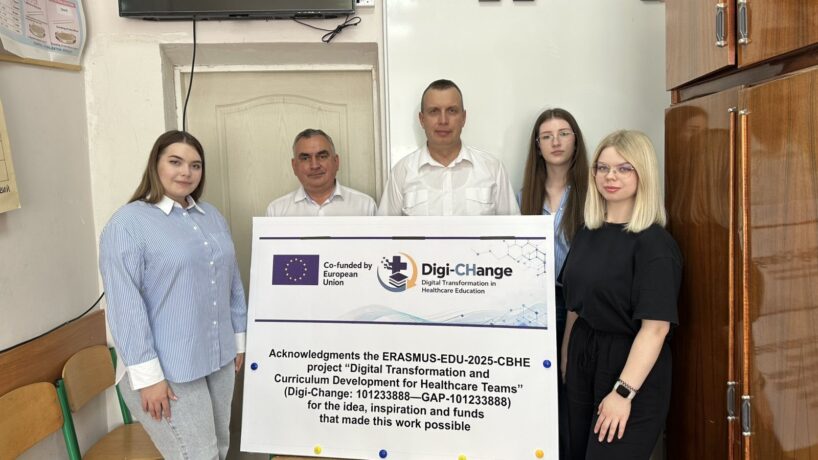
The primary goal of the Digi-CHange project is the digitalization of the medical curriculum and the development of a modern concept of medical education through the following objectives:
- Reforming curricula to promote the digitalization of medical education.
- Establishing Digi-CHange laboratories in partner higher education institutions.
- Creating a Digi-CHange network to facilitate collaboration among digital skills laboratories.
- Developing AI-based simulations specifically tailored for medical education.
- Designing methodologies and tools for assessing digital health competencies.
- Raising awareness of digital health.
The project focuses on reforming medical and nursing curricula to better reflect real-world healthcare practice, where digital tools, data, and artificial intelligence increasingly support clinical decision-making.
The Digi-CHange project contributes to strengthening healthcare systems, improving professionals’ readiness for digital transformation, and aligning educational programs with European and global priorities in digital health.
At TNMU, the expected outcomes include updated educational programs, the creation of new courses, and enhanced learning efficiency through the integration of digital tools and artificial intelligence technologies.
The views and opinions expressed are solely those of the authors and do not necessarily reflect those of the European Union. Neither the European Union nor the Erasmus+ program can be held responsible for them.