

A Local History Event, “Historical and Cultural Heritage and Environmental Challenges of Ternopil Region” at the Physiology Department
On November 5, 2024, the Department of Physiology, with courses in bioethics and biosafety, hosted a local history event, “Historical and Cultural Heritage and Environmental Challenges of Ternopil Region.” Professor Stepan Vadzyuk, head of the department, addressed the attendees, stating, “Today’s event is an important step in our effort to preserve and better understand the historical and cultural heritage of our native Ternopil region, as well as to discuss the environmental challenges it faces. We live in a time when nature and culture are closely intertwined, and their preservation is one of the main tasks of modern society.”
The event began with a presentation by student Nataliia Shtonyk, who shared insights about her native town of Buchach.

Buchach is a town in western Ukraine, in Ternopil region, with a rich and unique history, making it attractive from historical and cultural perspectives. Its name first appeared in chronicles in the 14th century. Over the centuries, Buchach was part of Poland, Lithuania, the Austrian Empire, and later the Austro-Hungarian Empire. This rich history is reflected in the town’s cultural and architectural appearance.


Located in the picturesque valley of the Strypa River, Buchach is appealing to tourists, surrounded by hills and forests that add a unique charm. The river has been essential to the town’s economy since ancient times, with mills and other structures built along its banks. The Strypa River also supported fishing and agriculture in the area.
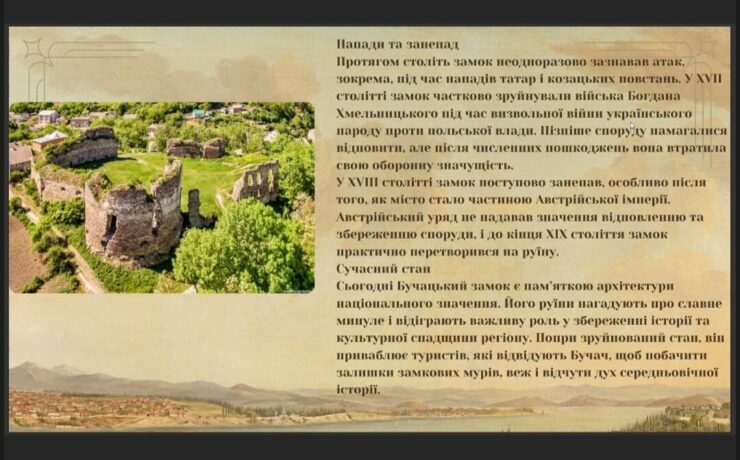
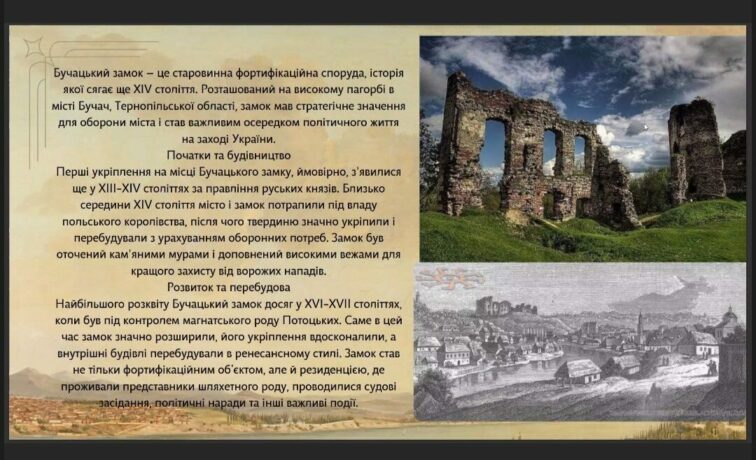
Among Buchach’s architectural monuments are Buchach Castle, Pidzamochiv Castle, the Basilian Monastery, and Buchach Town Hall, with sculptures by the renowned Ukrainian sculptor Johann Georg Pinsel. Buchach is also the birthplace and workplace of many prominent figures, including Nobel Prize-winning writer Shmuel Yosef Agnon, celebrated singer Solomiya Krushelnytska, and Osyp Nazaruk, author of the novel Roksolyana.
In closing her presentation, Nataliia Shtonyk remembered local soldiers who lost their lives in the current war, including Stepan Kokhanovskyi, Ihor Shtonyk, Ivan Trynka, and Mykhailo Hohol.
Student Viktoriia Khanas shared information about her native village of Romanivka in Ternopil District.

Romanivka is home to the stone church of St. Nicholas, the oldest Christian temple in the village. Ruins of a Roman Catholic church built in 1912 can also be found here.
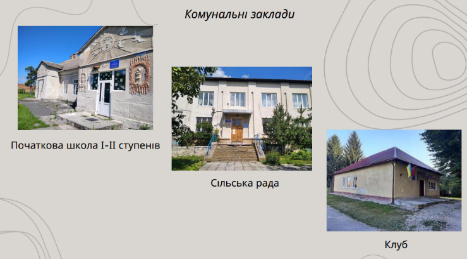
Romanivka is the birthplace of notable figures such as Roman Hevko, Honored Worker of Agriculture of Ukraine, writer and public figure Yaroslav Hevko, manager and public figure Vasyl Didukh, religious figure and national liberation activist Vasyl Kuzma, chemist and public-cultural figure Uliana Skalska, lawyer and public figure Viktor Tsebrovskyi, and artist, graphic artist, and sculptor Yakiv Yahoda (b. 1932).
In concluding her presentation and the event, Viktoriia Khanas paid tribute to the fallen heroes in the Russian-Ukrainian war, including Viktor Pazinskyi, Mykhailo Vehera, Nazar Voloshyn, Andrii Medvid, Yurii Sydor, Oleh Svyryd, and Yurii Mykhailetskyi.