

Philosophy and Fundamentals of Academic Integrity: Guest Lecture for First-Year Students of the Faculty of Dentistry at TNMU
As part of the study of the educational component “Philosophy and Fundamentals of Academic Integrity” by first-year students of TNMU, and on the initiative of Professor V. Kulchytskyi, Head of the Department of Higher School Pedagogy and Social Sciences, a series of guest lectures on the topic “Fundamentals of Academic Integrity” has been launched.
On October 17, 2025, the second lecture of this series took place for students pursuing higher education under the Educational and Professional Program “Dentistry” of the second (master’s) level in the field of Health Care and Social Welfare, specialty 221 “Dentistry” (first-year students). The event was also attended by lecturers from the Department of Higher School Pedagogy and Social Sciences of TNMU.
The lecture was delivered by Viktoriia Stepanenko, Doctor of Pedagogical Sciences, Professor at the Department of Social Work and Higher School Pedagogy of Lesya Ukrainka Volyn National University.

The speaker is the guarantor of the Educational and Professional Program “Social Work. Social Pedagogy” (Master’s level, specialty 231 Social Work). She is a member of the Ukrainian Educational Researchers Association (UERA) and serves on the editorial board of the scientific professional journal “Courtesy. Humanitas” of Lesya Ukrainka Volyn National University.
Professor Stepanenko participated in the academic integrity promotion project “STOP-Plagiarism” (May – November 2021). In addition, she is a researcher in the grant project of the National Research Foundation of Ukraine, titled “Formation of Critical Thinking among Citizens as a Factor of Security under Conditions of Armed Violence and Information Aggression in Eastern Ukraine.”
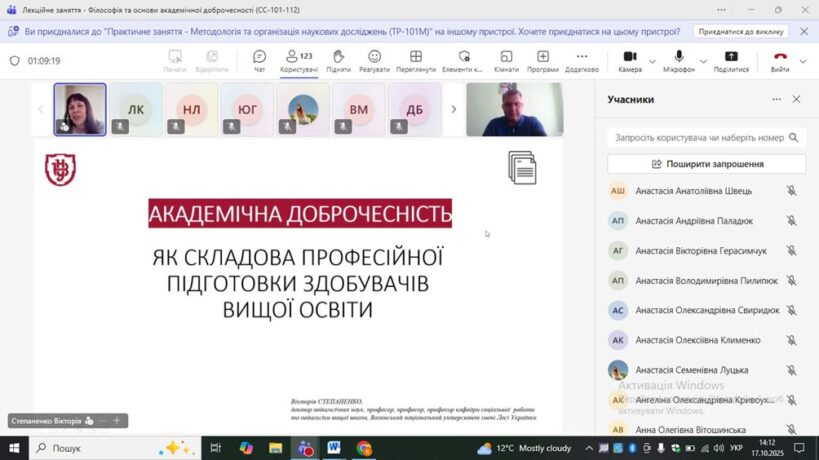
The topic of the lecture — “Academic Integrity as a Component of Professional Training of Higher Education Students” — stood out for its high relevance, scholarly depth, and practical significance.
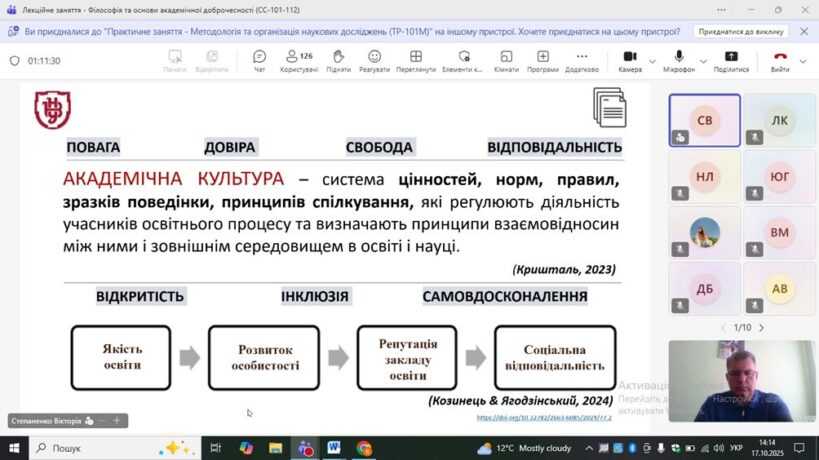
The lecturer explained the concept of academic culture and emphasized its key role in the modern educational and scientific environment. She highlighted that academic culture encompasses a system of values, norms, and rules that guide the behavior of researchers, teachers, and students. The main goal of academic culture is to foster a responsible attitude toward educational and research activities, promote the development of critical thinking, mutual respect, tolerance, and professional ethics. Adherence to the principles of academic culture ensures the development of an educational space built on trust, openness, and academic honesty.
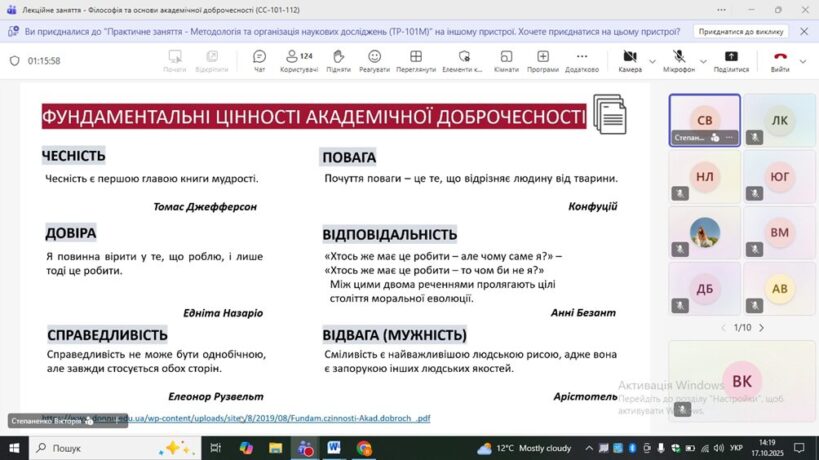
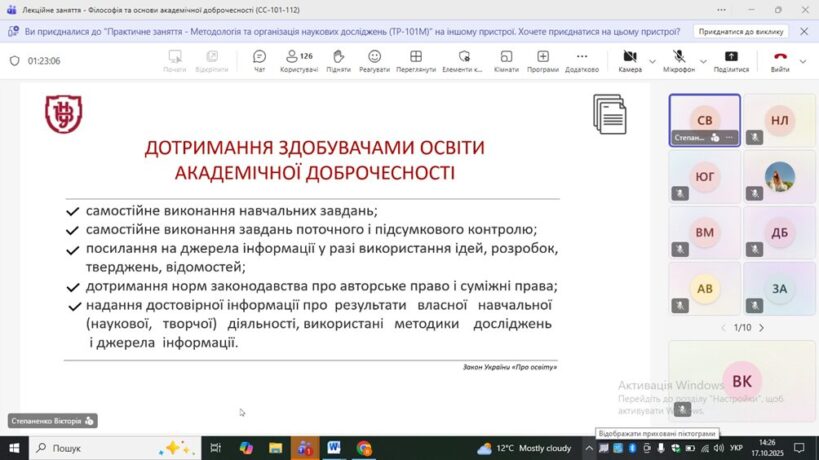
Particular attention was paid to the fundamental values of academic integrity, which form the moral and ethical foundation of educational and scientific activity. These values include honesty, trust, fairness, respect, responsibility, and courage. They foster a culture of mutual respect, ethical conduct, and a high-quality educational process. Commitment to these principles strengthens the reputation of higher education institutions, contributes to the development of the academic community, and cultivates responsible and morally mature individuals.
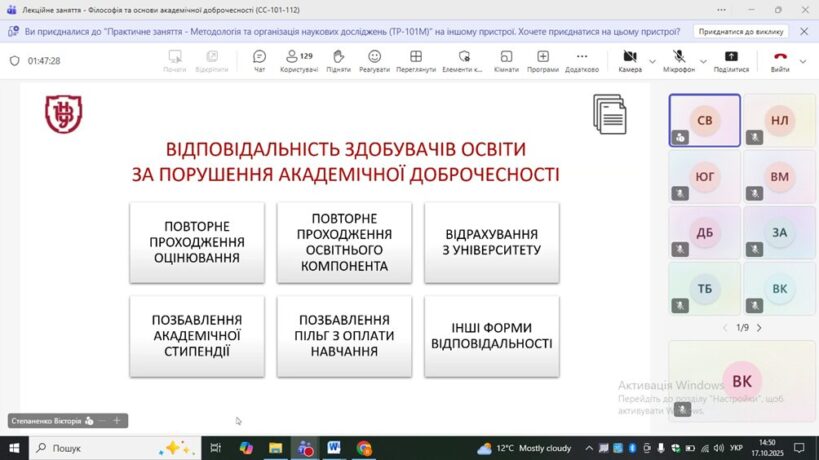
A detailed discussion focused on the students’ adherence to the principles of academic integrity, which involves not only formal compliance with established rules but also a conscious acceptance of ethical standards in academic and research activities. Academic integrity is viewed as an integral part of a professional’s formation — reflected in honesty during academic tasks, independent thinking, responsibility for one’s work, and respect for others’ intellectual property. Observing these principles contributes to the development of personal inner culture aligned with the corporate ethics of the university, ensuring a high level of trust in educational outcomes.
The event took place at a time when strengthening academic integrity in the educational environment is particularly important, highlighting its significance and practical value. The atmosphere of open dialogue, strong engagement of participants, and productive feedback fostered a constructive professional discussion. The lecture not only provided practical recommendations but also fulfilled an important educational role, promoting awareness of the key aspects of academic integrity.