

Philosophy and Fundamentals of Academic Integrity: A Guest Lecture for First-Year TNMU Medical Students
As part of the course “Philosophy and Fundamentals of Academic Integrity” for first-year students of I. Horbachevsky Ternopil National Medical University, a series of guest lectures on academic integrity is being implemented at the initiative of Professor Volodymyr Kulchytskyi, Head of the Department of Higher Education Pedagogy and Social Sciences.
On October 24, 2025, the third lecture of this series was held for students enrolled in the educational and professional program “Medicine” (Master’s degree, first-year, first stream) in the field of knowledge “Health Care and Social Welfare.” The event was also attended by faculty members of the Department of Higher Education Pedagogy and Social Sciences of TNMU.
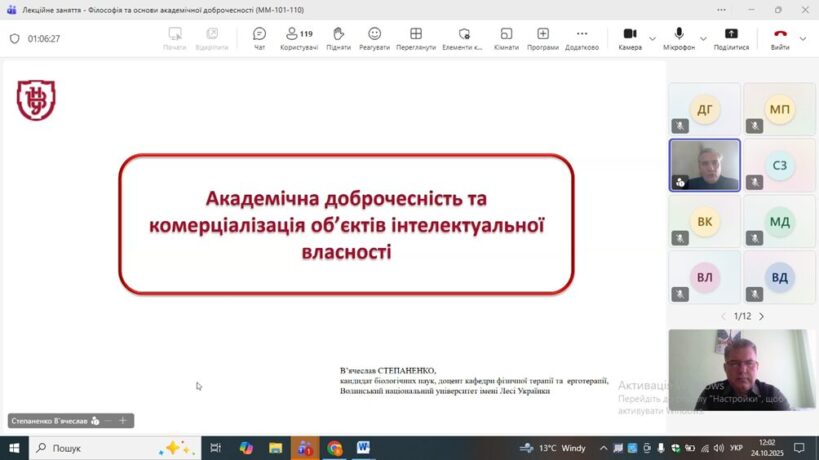
The lecture was delivered by Viacheslav Stepanenko, PhD in Biological Sciences, Associate Professor, and Deputy Dean for Academic Affairs at the Faculty of Medicine, Lesya Ukrainka Volyn National University.

The topic of the lecture — “Academic Integrity and the Commercialization of Intellectual Property Objects” — was highly relevant, scientifically profound, and of significant practical value.
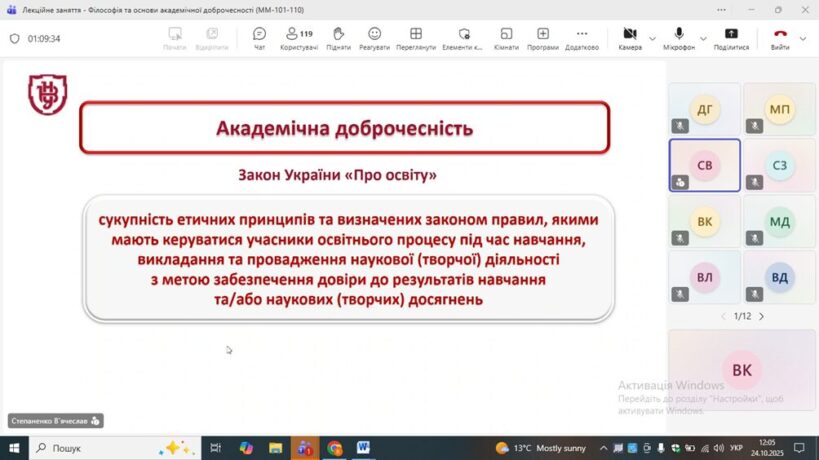
The speaker explained the concept of academic culture, emphasizing its essential role in the modern educational and scientific environment. He noted that academic culture is a comprehensive system of values, norms, rules, behavioral models, and principles of communication that govern the activities and relationships of all participants in the educational process — researchers, educators, and students. The main goal of academic culture is to foster a responsible attitude toward learning and research, develop critical thinking, mutual respect, tolerance, and professional ethics. Adherence to these principles ensures the creation of an educational space built on trust, openness, and scientific integrity.

A detailed analysis was also devoted to the concept of copyrighted works — the results of intellectual and creative activity protected by law. Such works are viewed not only as products of individual creativity but also as key elements of the cultural and scientific development of society. These include literary, artistic, musical, and scientific works, computer programs, databases, audiovisual works, and other original results expressed in a tangible form. Understanding the importance of copyrighted materials helps students develop respect for intellectual property, a sense of responsibility when using others’ creative outputs, and motivation for their own innovative activity. Observance of copyright laws is an integral component of academic culture and the ethical behavior of future professionals.


The event served as an important platform for discussing the relationship between adherence to the principles of academic integrity and the effective use of intellectual property in today’s scientific and educational space. The discussion helped participants recognize that cultivating a culture of integrity is an essential part of the process of commercializing scientific developments. The atmosphere of open dialogue, the participants’ high level of engagement, and the practical focus of the lecture contributed to a deeper understanding of the importance of combining ethical principles with innovative potential in education and research.