

July 31: The AI Law Comes into Force
July 31, 2026, is not just another date on the calendar. It marks the day when the Law of Ukraine No. 4742-IX “On Academic Integrity” comes fully into effect and begins to have practical consequences for every university, department, and academic staff member. AI detection and verification become a legal obligation rather than a matter of administrative discretion.
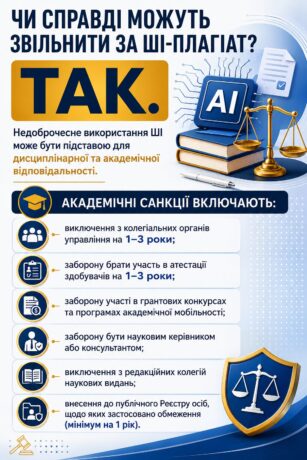
After this date, any higher education institution (HEI) that has not updated its academic integrity system will automatically face the risk of accreditation sanctions. Moreover, an academic found guilty of dishonest use of AI may be entered into a public register of offenders or even lose their position.
This article focuses on the essentials: what universities must do before July 31, what sanctions may be imposed on academic staff, and which AI-detection tools are already being used in Ukraine.
The Verkhovna Rada adopted Law No. 4742-IX “On Academic Integrity” on December 18, 2025. The President signed it on January 29, 2026, and it entered into force on February 1. However, according to the Final and Transitional Provisions, higher education institutions have six months to bring their internal regulations into compliance—until July 31, 2026.
Previously, academic integrity provisions were dispersed between Article 42 of the Law “On Education” (2017) and Article 22 of the Law “On Higher Education” (2014). The new legislation is a comprehensive and independent law regulating academic integrity across secondary education, higher education, research, and the awarding of academic degrees. Clarifications regarding implementation deadlines and the new powers of the National Agency for Higher Education Quality Assurance (NAQA) were published on February 17, 2026 (Protocol No. 3(94), Appendix 9).
In parallel with the Law, Cabinet of Ministers Resolution No. 928 of July 30, 2025, remains in effect. Under this regulation, candidates for the Doctor of Sciences degree must sign a declaration on the title page of their dissertation confirming that all sections generated with the assistance of AI have been personally reviewed and edited by them.
The Law establishes differentiated sanctions depending on the type of violation.
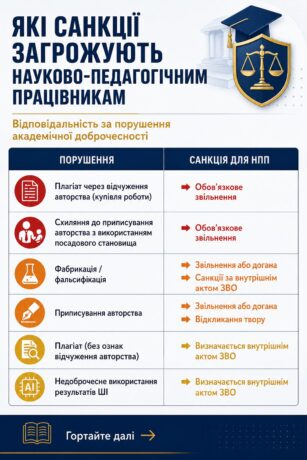
Mandatory dismissal is foreseen for the misappropriation of authorship. However, in cases of dishonest AI use, the specific sanction is determined by the university from the list established by the Law. Consequently, each institution must define in its internal regulations the penalties applicable to academic staff, such as reprimands, dismissal, prohibition from supervising doctoral students, or removal from editorial boards.
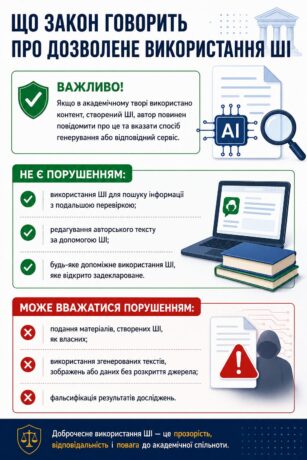
To avoid inclusion in the register of offenders, it is essential to understand what constitutes a violation. Institutions should ensure that academic staff are aware of the relevant requirements and restrictions regarding AI use.
Documents Universities Must Adopt or Update by July 31, 2026
By July 31, 2026, higher education institutions must adopt or revise the following documents:
- Regulations on the Academic Integrity System in accordance with Law No. 4742-IX;
- Procedures for identifying and establishing violations, including a 10-day preliminary assessment period, mandatory determination of fault, and an appeals procedure;
- Regulations on the Use of Artificial Intelligence Technologies in Education and Research—this document becomes mandatory for the first time;
- Regulations on the Academic Integrity Commission (or Authorized Body), including powers and mechanisms for preventing conflicts of interest;
- A Code of Academic Integrity, or an updated version of the existing code;
- Requirements for course syllabi, including clear assessment criteria and rules governing AI use in assignments;
- Procedures for reviewing and checking academic works before publication.
All institutional documents must be published on the university’s official website. Any regulations affecting students must also be approved by the student self-government body.
Requirements for academic journals have also changed, introducing new standards for scholarly publications.
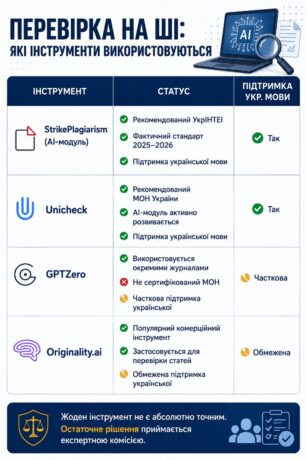
AI Detection Tools Used in Ukraine
Neither the Ministry of Education and Science nor NAQA has designated a single mandatory AI-detection tool. Nevertheless, a practical ecosystem has already emerged.
A notable example is StrikePlagiarism, which since December 2025 has included a comprehensive AI-detection module with an official PDF report accepted by universities. The system can identify content generated by ChatGPT and other large language models in more than 100 languages, including Ukrainian.
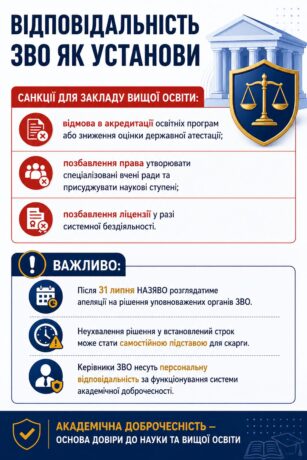
Institutional Responsibility
For the first time, the Law introduces the concept of an institutional violation of academic integrity. This refers to situations in which a university, through its actions or inaction, contributes to the spread of academic misconduct. Failure to establish and maintain an effective integrity system may itself constitute a violation.
AI verification is no longer merely an internal departmental matter. It is now a legal obligation for which both individual academics and higher education institutions bear responsibility.