

TNMU Researcher Conducts Study at Keele University as Part of the “MSC-Derived Extracellular Vesicles as a Cell-Free Therapy for Burn Injuries” Project
As part of the joint research project “MSC-Derived Extracellular Vesicles as a Cell-Free Therapy for Burn Injuries,” funded by the Cormack Consultancy Group through the Seed Fund for Research Excellence grant programme, a representative of TNMU undertook a working visit to the United Kingdom in the field of regenerative medicine.
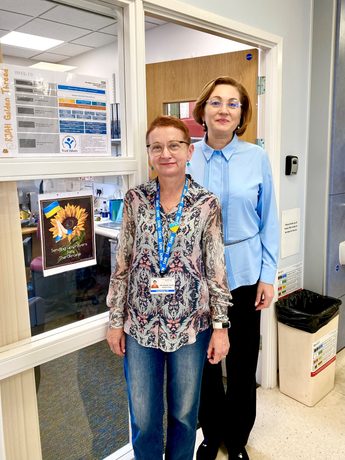
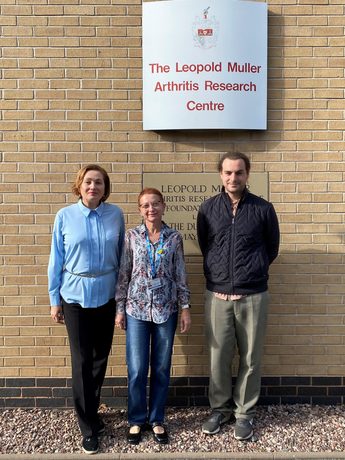
From 11 to 20 September 2026, Alina Dovhaliuk, Associate Professor of the Department of Histology and Embryology and Head of the Cell Culture Unit of the Interdepartmental Educational and Research Laboratory Centre at TNMU, conducted research at Keele University. The scientific work was carried out at the research laboratory of the Robert Jones and Agnes Hunt Orthopaedic Hospital (RJAH Orthopaedic Hospital) in Oswestry under the direct supervision of leading British specialists.
The joint research was conducted in close collaboration with the Oswestry Keele Orthopaedic Research Group (OsKOR). The project’s main partner and mentor was Dr Oksana Kehoe, PhD, Reader in Inflammation Biology, Head of the Rheumatology Laboratory and Director of Postgraduate Research at the Faculty of Medicine and Health Sciences, Keele University.
The experimental work was also actively supported by young British researcher Henry Barrett, a PhD student at the laboratory, whose research focuses on the therapeutic potential of extracellular vesicles in the treatment of inflammatory processes.
The main purpose of the visit was to carry out the first stage of the joint research and gain practical experience in advanced high-technology methods for the isolation, priming, and multiparametric analysis of exosomes derived from human umbilical cord stem cells.
During the intensive laboratory work, the following tasks were successfully completed:
- Extracellular vesicles were isolated from mesenchymal stem cells derived from the umbilical cord (UC-MSCs) obtained from three donors.
- Maternal UC-MSCs were primed with pro-inflammatory cytokines (TNF-α, IFN-γ, and IL-1β).
- The vesicles were immunophenotyped using specific exosomal markers (CD9, CD63, and CD81), and BCA protein assays were performed.
- Exosome aliquots were prepared for subsequent nanoparticle tracking analysis, cryo-electron microscopy, and transcriptomic studies. The analysed vesicle aliquots have already been delivered to TNMU for microRNA profiling using PCR analysis.
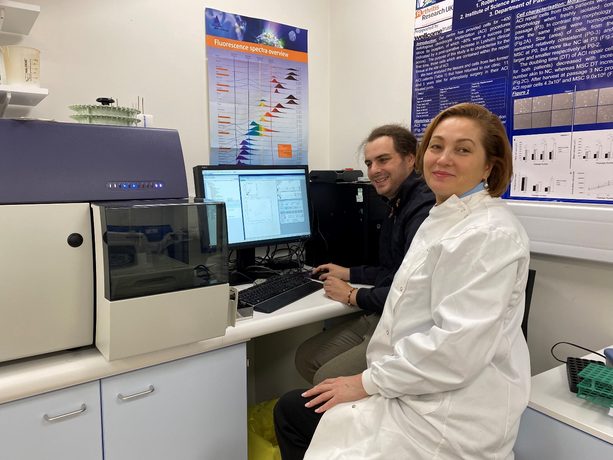
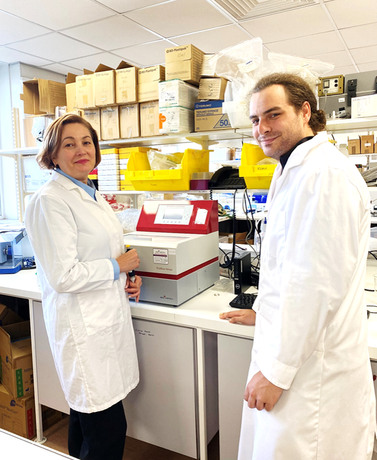
The visit also provided the TNMU representative with an opportunity to gain detailed practical knowledge of the operation and software of advanced laboratory equipment used in the United Kingdom, including:
- the FACSCanto II flow cytometer and FlowJo® software;
- the FLUOstar Omega plate reader;
- the L8-70M (Beckman Coulter) ultracentrifuge and Panasonic cryogenic storage system;
- the Leica TCS SP5 confocal microscope.
A series of discussions with British colleagues was also held. The discussions resulted in an agreement to prepare joint publications for high-ranking scientific journals and to explore future grant applications in the fields of orthopaedics and rheumatology. The visit also enabled the researchers to establish contacts with new scientists at Keele University’s Centre for Science and Technology in Medicine who had not previously been part of the current research team.
Direct work with cellular material at the British orthopaedic hospital will contribute to the accuracy and reliability of the subsequent stages of the project. Further research will be carried out in parallel: the British team will focus on nanoparticle tracking analysis and cryo-electron microscopy, while the Interdepartmental Educational and Research Laboratory Centre at TNMU will conduct PCR-based analysis of the microRNA profile and investigate the therapeutic efficacy of the obtained extracellular vesicles using an in vitro burn injury model.