

An ecological and local lore meeting “Ternopil – City of Freedom and Knowledge” was held at the Department of Physiology with Bioethics
A long-standing tradition of ecological and local lore events, organized under the slogan “Ukraine is One,” has been formed at the Department of Physiology with Bioethics. Thanks to this, students have the opportunity to learn about new places in Ukraine, share interesting information about their own small homelands, and also remember those who gave their lives in the Russian-Ukrainian war.
The meeting was opened by the Head of the Department, Doctor of Medical Sciences, Professor Stepan Vadziuk, noting the importance of uniting the students with the understanding that Ternopil is not only the city of their student years, but also a space where their national self-identification is formed or strengthened.
Students of MM-217 Mariana Bobyk and Sofiia Bodnar prepared a report “History of Ternopil, TNMU, and the Historical Role of I.Ya. Horbachevsky” (curator Associate Professor N.V. Volotovska).
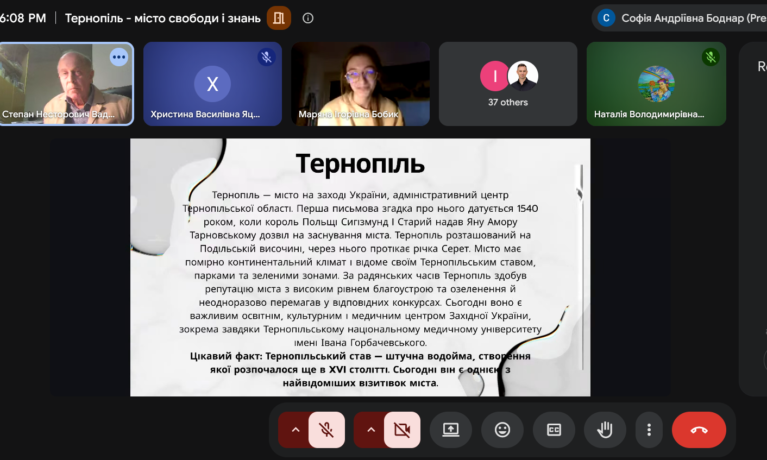
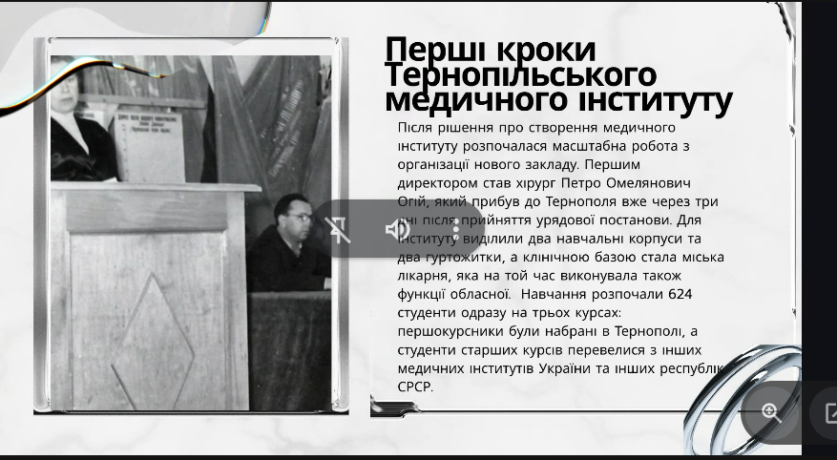
After the declaration of Ukraine’s independence, the Ternopil Medical Institute received new opportunities for development and, in 1992, the name of the outstanding Ukrainian biochemist Ivan Horbachevsky. In 2004, the institution became a university, and in 2019, it received national status – I. Horbachevsky Ternopil National Medical University. Ya. Horbachevsky.
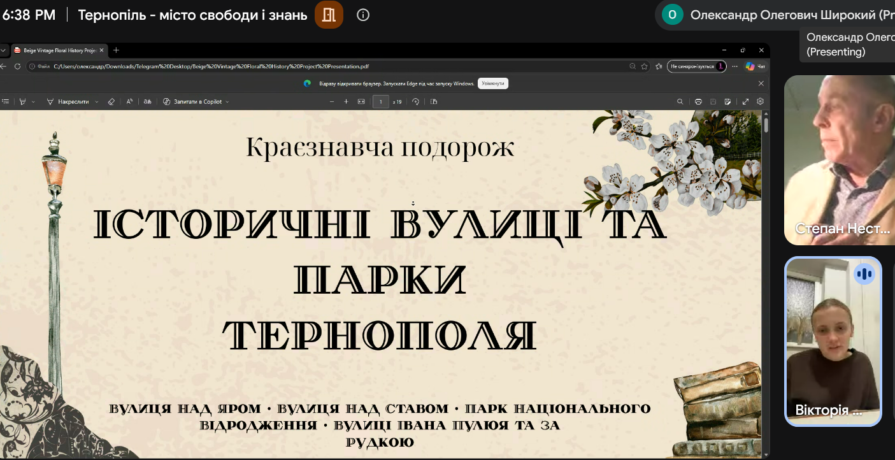
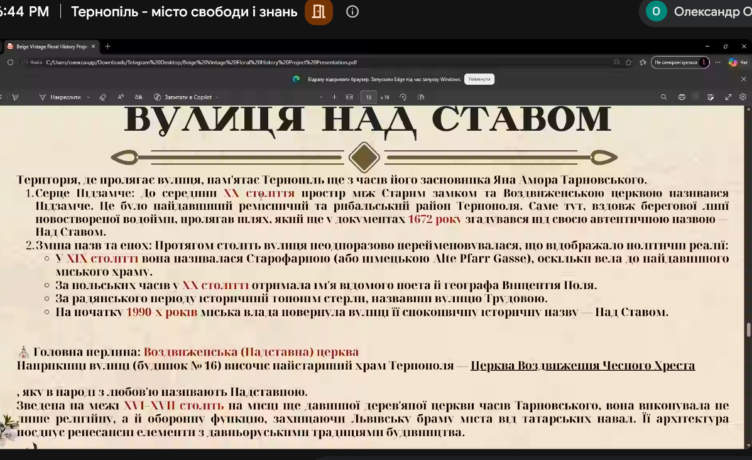
The second report was dedicated to the development of the city of Ternopil itself, where students of MM-218 Viktoriia Stetsko, Diana Matlaha, and Oleksandr Shyrokyi (curator Associate Professor I.Z. Kernychna) prepared interesting historical facts about the etymological curiosities of such streets as Nad Yarom, Hytsli, which comes from the word “hytsel” (dog catcher) or a chicken coop; the second historical name of this street is also Cappadocia. They also spoke about Nad Stavom Street (the Church over the Pond, in addition to its direct purpose, also played the role of a fortification, protecting the city center from Turkish raids from the side of the Lviv Gate). Regarding Za Rudkoiu Street, its name arose in connection with the presence of the bed of the river of the same name in this place, which, unfortunately, has now disappeared. Separately, it was interesting to hear about the development of the National Renaissance Park.
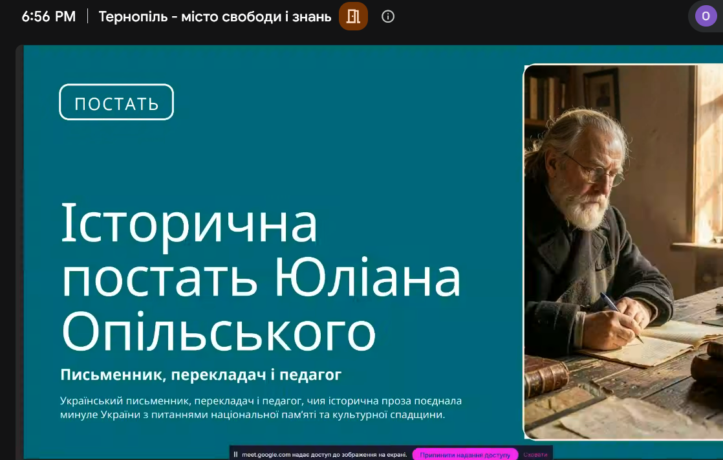
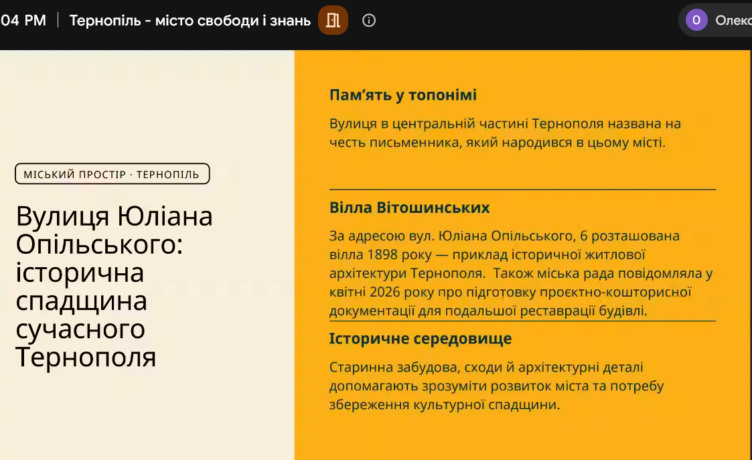
Student MM-216 Oleksandr Tesliuk (curator Associate Professor T.I. Tolokova) prepared a report “Historical Figure of Yulian Opilsky.” The report highlighted the life path, creative work, and significance of the figure of Yulian Opilsky in the historical and cultural development of the Ternopil region. Special attention was paid to his contribution to the preservation of national memory and the popularization of Ukrainian history.
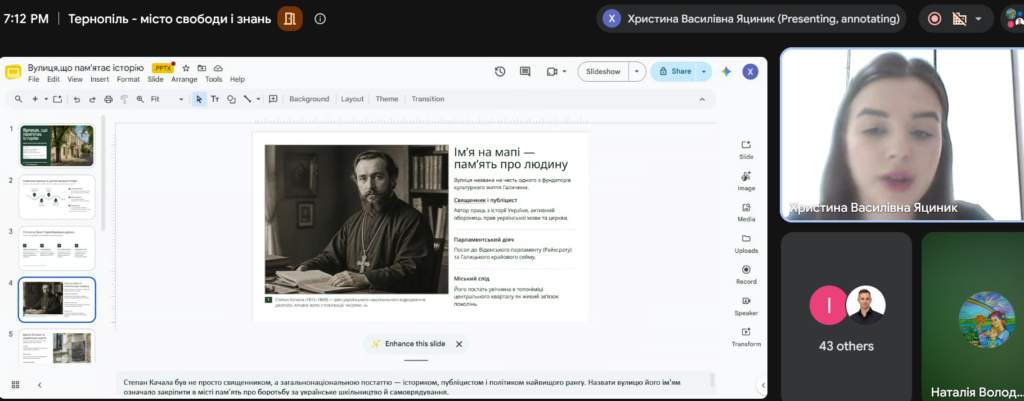
The final presentation was about Stepan Kachala Street, prepared by student MM-215 Khrystyna Yatsynyk (curator Associate Professor N.Ye. Ziatkovska). Sometimes, to learn more about the space around you, it is worth just stopping and looking around. On Stepan Kachala Street, the history of the bursa attracts attention – an institution where, thanks to Andrii Kachala, Ukrainian children from other cities could live and receive an education, while funds for their maintenance were collected by caring Ternopil residents. The name “bursa” itself comes from the Latin bursa – “bag,” because at the entrance there was a box-bag for donations for the maintenance of students from different regions, who thus had a better chance of studying in the city.
The material was prepared by the person responsible for national-patriotic education of the department, Associate Professor N.V. Volotovska.