


Open Science in TNMU
Open Science is a new model of scientific activity based on the principles of transparency, accessibility, collaboration, and ethics. According to the UNESCO Recommendation (2021), it is a concept that ensures open access to scientific publications, data, methodologies, and educational materials while encouraging public participation in research. The goal of Open Science is to enhance the quality, efficiency, inclusivity, and innovativeness of science.
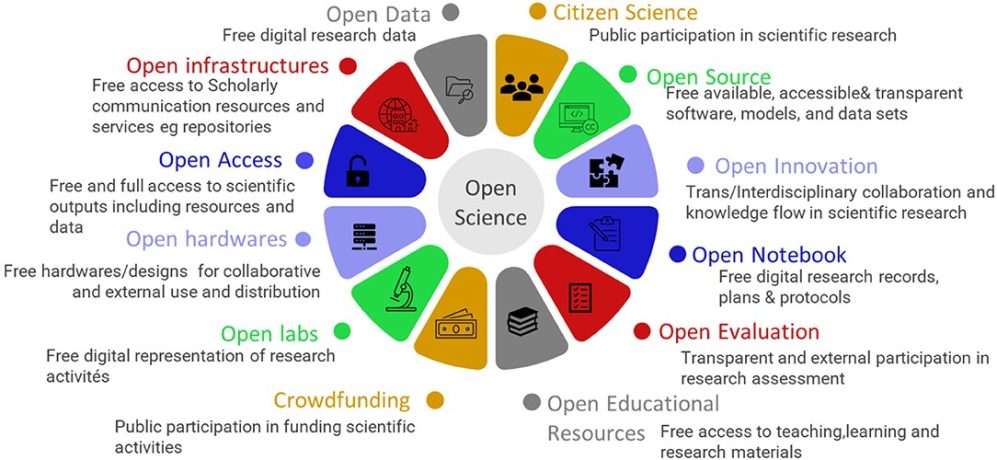
Open Access (OA) is a publishing model that provides free, unrestricted access to research outputs for all users. It applies to scientific articles, research data, reports, and other forms of scientific communication.
Licensing is a crucial tool in Open Science. It enables legal and transparent knowledge sharing while respecting intellectual property. The right license promotes dissemination, reuse, and research impact.
Open licenses are used across Open Science, Open Access, and OER to allow free use under specific conditions.
The most common are Creative Commons (CC) licenses:
- CC BY 4.0 — allows any use with required attribution. Recommended for Open Science.
- CC BY-SA — use permitted if derivative works are licensed identically.
- CC BY-NC — non-commercial use only.
- CC BY-ND — redistribution allowed without modifications.
- CC0 — waiver of all rights (Public Domain).
Example in Open Science
An article licensed under CC BY 4.0 can be:
- Read and saved
- Translated
- Used in textbooks
- Cited in publications — with appropriate attribution
Article Versions
- Preprint — version before peer review (e.g., arXiv, bioRxiv, medRxiv, SocArXiv)
- Postprint — peer-reviewed version, accepted but not journal-formatted
Open Access Models
- Gold OA — fully open journals; immediate access upon publication; often requires author fees (APC)
- Diamond/Platinum OA — open journals with no charges for authors or readers; funded by institutions or sponsors
- Green OA — authors self-archive in open repositories (e.g., Zenodo, institutional repositories), often after embargo
- Hybrid OA — subscription journals with paid open access option for individual articles
Embargo Period
A compromise between traditional publishing and OA, this period restricts full-text access after publication (typically 6, 12, or 24 months depending on the journal).
- Common in medicine: 6–12 months
- Postprint can be legally deposited in repositories after the embargo
Purpose of Embargo
- Enables publication in prestigious journals
- Allows later open sharing (Green OA)
- Doesn’t contradict Open Science, but delays access
- Funders (e.g., Horizon Europe, Erasmus+, NSF, USAID) increasingly require zero or short embargo
Open Access Journals (Gold, Diamond) publish without embargo.
Institutional Repositories and Open Access
Institutional repositories are digital platforms that ensure open access to scholarly materials such as publications, dissertations, reports, and research data. They facilitate Green Open Access by enabling researchers to upload preprints or postprints of their work.
The Repository of Ternopil National Medical University — https://repository.tdmu.edu.ua/ — provides open access to the university’s scientific publications and research outputs.
UNETHICAL PUBLISHING PRACTICES
Unethical publishing violates the principles of academic integrity and includes:
Predatory Journals — charge fees without proper peer review, editing, or archiving; may use fake impact factors.
Signs include:
- Lack of transparent editorial policy
- Aggressive publishing invitations
- Questionable editorial board
- Mimicking reputable journal names
Paper Mills — commercial entities that create or sell fake articles, often using fabricated data.
Salami Slicing — splitting one study into multiple narrow papers to increase publication count; undermines research integrity.
Other Unethical Practices:
- Guest authorship (including non-contributors)
- Plagiarism/self-plagiarism
- Data fabrication or falsification
- Duplicate submissions
- Fake peer review
Open Data
Open scientific data are digital datasets created or used in research and made publicly available for viewing, analysis, reuse, and distribution with no or minimal restrictions. These may include numerical tables, audio/video files, images, code, metadata, lab notebooks, and protocols.
According to OECD (2015) definition, data are open if licensed for free use, modification, and redistribution by anyone.
Categories of Research Data:
- Primary (Raw) Data – directly obtained (e.g., biochemical test results, survey responses)
- Processed Data – cleaned, recoded, or normalized (e.g., summary tables, averages)
- Analyzed/Interpreted Data – results of statistical analysis (e.g., graphs, models)
- Simulated/Modeled Data – generated by computer simulations (e.g., 3D models)
- Supporting Data – protocols, notebooks, code, etc.
- Confidential/Sensitive Data – includes personal or sensitive info; requires anonymization/encryption
- Metadata – “data about data”; describes content, structure, context, authorship, format, keywords, and access terms
FAIR Principles for Open Data
- Findable – data must be indexed and uniquely identified (e.g., DOI)
- Accessible – clear access conditions, even for restricted data
- Interoperable – formatted for exchange across systems
- Reusable – licensed for reuse and documented
Benefits of Open Data
- Improved reproducibility
- Reduced duplication of effort
- Wider dissemination
- New discoveries from existing data
- Citizen science engagement
Legal & Ethical Aspects
- Data protection laws (e.g., GDPR)
- Anonymization of sensitive data
- Restrictions for commercial/defense/intergovernmental data
Open Data Repositories
- Zenodo – EU-supported, for publications, data, code; includes DOI, licensing
- Figshare – accepts all formats, integrates with ORCID
- arXiv – preprint archive (physics, math, comp sci, etc.)
- Dryad – focus on life sciences
- GitHub – for code sharing and collaboration
Institutional Repositories and Open Data
Local repositories serve not only as archives for publications but also as secure storage for research data, ensuring their integrity and alignment with FAIR principles.
The Ternopil National Medical University Repository — https://repository.tdmu.edu.ua/ — provides open access to academic publications and research data, supporting transparency, long-term preservation, and adherence to FAIR principles.
Data Management Plan (DMP)
A DMP outlines how data will be collected, stored, processed, documented, and shared during and after a project. Required in many funding programs (e.g., Horizon Europe).
Key DMP Elements:
- Types of data generated
- Storage and backup methods
- Dissemination and access plans (e.g., open repositories)
- Legal/ethical restrictions (e.g., GDPR, anonymization)
- Metadata formats, standards, and licenses (e.g., CC BY 4.0, FAIR)
DMP-guided Open Data Publication
Should predefine:
- What data will be made open, and when
- Format and metadata
- Chosen license (e.g., CC BY, CC0)
- Long-term access and preservation
Useful Resources:
- RE3data.org – global registry of data repositories
- GO FAIR Initiative – promotes FAIR principles
- OpenAIRE Guidelines – technical standards for repository compatibility
• CODATA – Committee on Data for Science and Technology (ICSU)
Open Methods and Tools
Open Methods refer to the publication of methodologies, protocols, code, and tools that allow results to be reproduced and verified. Transparency in methods builds trust and supports reuse.
Key tools in Open Science include:
- Preprint platforms (e.g., arXiv, bioRxiv)
- Data management systems (e.g., Open Science Framework)
- Analysis and visualization tools
- Impact metrics services (e.g., Altmetric, Dimensions)
Institutional Policies Supporting Open Science
Institutional support is vital for successful Open Science implementation. Such policies may require:
- Open Access publishing
- Mandatory DMPs
- Compliance with ethical standards
- Incentives for open collaboration
Open Science Metrics
Beyond traditional citations, open publications and data can be evaluated via altmetrics, reflecting social impact, media mentions, and engagement on social platforms. These help researchers understand their reach and audience.
Core Values of Open Science
- Equal access to knowledge regardless of geography or finances
- Transparency at all stages of the research process
- Accountability to society • Fairness and respect for the rights of all participants
- Public trust in science
Open Educational Resources (OER)
Open Educational Resources are learning materials, courses, textbooks, and video lectures that are freely available for use, modification, and distribution. They contribute to the democratization of education, improve learning outcomes, and support the principles of Open Science by ensuring access to quality education regardless of location or financial status.
Examples of popular platforms:
- Health Education Assets Library (HEAL)
- Merlot Dentistry Collection
FAIR and CARE Principles
The FAIR and CARE principles promote ethical, efficient, and responsible scientific data management in the context of Open Science. In many studies, both approaches should be combined, especially when dealing with human-related data.
FAIR (Findable, Accessible, Interoperable, Reusable) — technical principles ensuring data’s maximum scientific and practical value:
- Findable: Data should be easily discoverable via metadata and unique identifiers (e.g., DOI).
- Accessible: Users can access the data (or at least its description) under clearly defined conditions.
- Interoperable: Data are presented in formats using standards that allow interaction between systems.
- Reusable: Data have licenses allowing reuse and are accompanied by documentation.
CARE (Collective Benefit, Authority to Control, Responsibility, Ethics) — ethical principles originally developed for data from Indigenous peoples and vulnerable communities but applicable in all contexts requiring social responsibility:
- Collective Benefit: Data should benefit not only science but also the communities that provided them.
- Authority to Control: Communities retain control over how their data are used.
- Responsibility: Researchers must manage, preserve, and share data responsibly.
- Ethics: All actions with data must meet ethical standards, including informed consent and privacy protection.
Benefits of Open Science
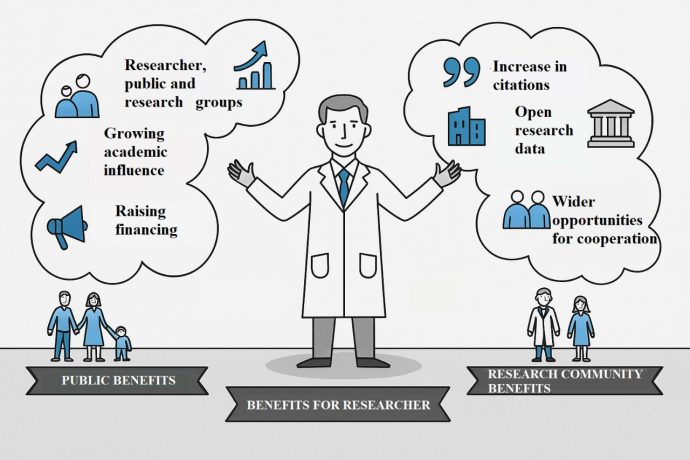
- Increased citation and research impact
- Improved quality and reproducibility of results
- Accelerated innovation
- Active public engagement in the scientific process
- Opportunities for transdisciplinary collaboration
Additional Resources
- UNESCO Open Science
- FOSTER Open Science MOOC
- Open Science MOOC – A free course (MOOC) that covers the basics of open access, open data, and software.
- Coursera: Open Science
- Educational and scientific electronic resources #StandWithUkraine