

TNMU PhD Students at the International LIVE 2026 Symposium in Greece
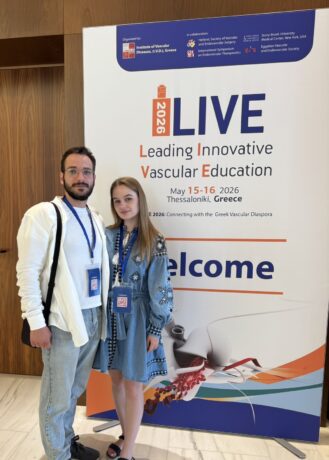
Ukrainian medical education and science continue to integrate into the international community, demonstrating a high level of professionalism even in the most challenging times. A vivid confirmation of this is the participation of TNMU PhD students, namely Olena Sas (a second-year PhD student and radiologist at the Life Scan Clinic, Kyiv) and Mykhailo Sas (a first-year PhD student and cardiac surgery resident at the M.M. Amosov National Scientific Center of Cardiovascular Surgery and Hereditary Pathology), in the prestigious international LIVE 2026 symposium, which this year took place in the Greek city of Thessaloniki.
The LIVE Symposium (Leading Innovative Vascular Education) is one of the most authoritative European platforms bringing together leading specialists in the field of medicine. This year, among the progressive medical community, the name of Ukraine was proudly represented as well.
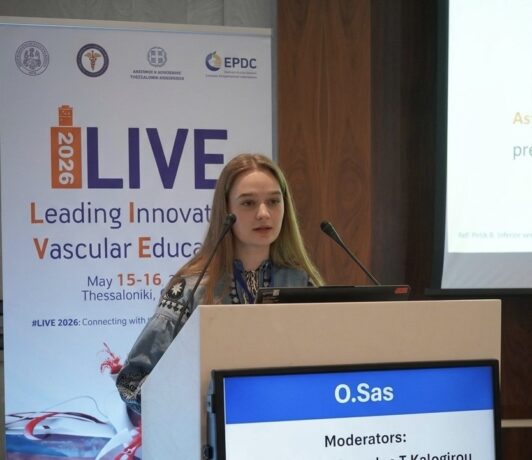
Olena Sas had the honor of delivering an oral presentation to European colleagues on an extremely rare and complex clinical case: “Complete agenesis of the infrahepatic inferior vena cava with azygos continuation: a crucial radiologic finding for cardiac surgical planning.” The presentation sparked considerable interest and discussion among international colleagues, as the timely detection of such a critical anatomical feature on CT scans by a radiologist significantly minimizes life-threatening risks during surgery. Clear communication between the diagnostician and the cardiac or vascular surgeon is critically important, confirming the relevance of Ukrainian doctors’ research and proving that Ukrainian radiology remains at the forefront of global innovation. Every such presentation reminds the world of the resilience of Ukrainian science and medicine.
“Having the opportunity to present our work at such a high level is both a great responsibility and an incredible honor. I am grateful to my colleagues for our joint efforts!” shared Olena Sas.
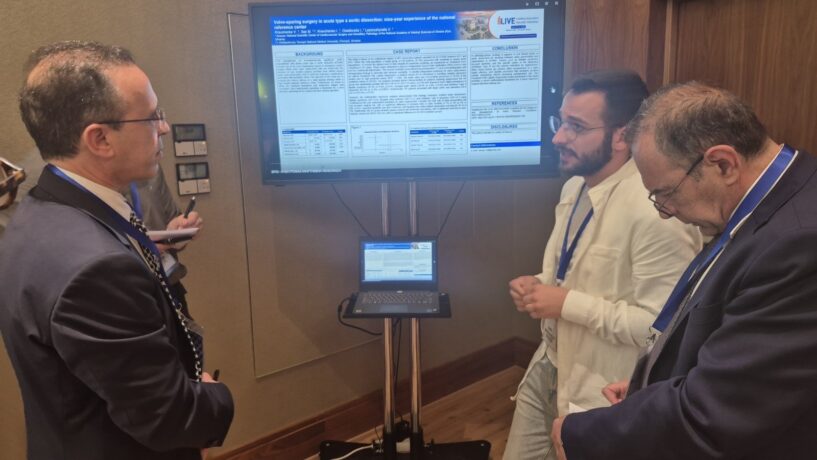
Mykhailo Sas presented a poster entitled “Valve-sparing surgery in acute type A aortic dissection: nine-year experience of the national reference center” to interested colleagues. The researcher outlined the scale of the problem, noting that acute type A aortic dissection carries an extremely high mortality rate without treatment, while preserving the aortic valve in such pathology represents a highly challenging task in cardiac surgery due to the extreme fragility of the aortic tissues during dissection.
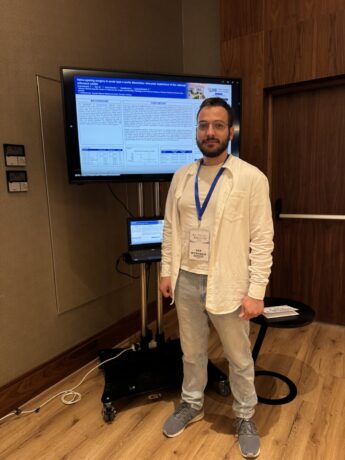
The PhD student analyzed the clinical effectiveness, safety, and technical limitations of various aortic valve-sparing techniques in acute type A aortic dissection and discussed the study results.
Mykhailo Sas noted: “In acute type A aortic dissection complicated by acute aortic insufficiency, replacing the aortic valve with a prosthesis is more commonly practiced, which carries certain risks for the patient’s quality of life after surgery. The analysis conducted at our National Center proves that, even under emergency conditions, it is possible in most cases to preserve the patient’s own valve, and the long-term outcomes of such interventions remain more than satisfactory.”
We continue moving forward, implementing advanced techniques and working for the health of patients and the future of Ukraine.