

Daily Care as the Foundation of Rehabilitation: Special Workshop “Our People Are Here [They Care]” by the Come Back Alive Initiatives Center for Future Physical Therapists of TNMU
On April 3, 2026, a special workshop for bachelor’s students of the “Therapy and Rehabilitation” program was held at the Department of Physical Therapy, Occupational Therapy, and Physical Education of I. Horbachevsky Ternopil National Medical University.
The event was organized by Solomiia Hyz, a first-year Master’s student in “Therapy and Rehabilitation,” assistant physical therapist, and participant of the project “Our People Are Here [They Care]” by the Come Back Alive Initiatives Center.
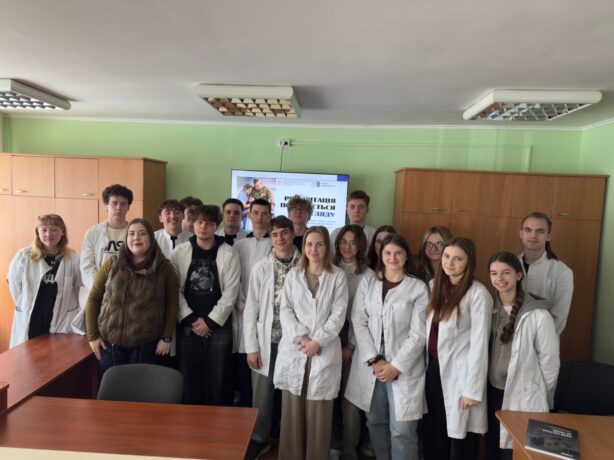
During the workshop, students, together with the speaker, explored what can undermine the rehabilitation process within just a few days: pressure ulcers, contractures, injuries during patient transfer, chronic pain, and patient exhaustion. Even a minor positioning error can set a patient back by weeks — this is not a hypothesis but a daily reality in clinical practice.
Special attention was given to working with veterans. Many of them live with the consequences of amputations, spinal cord injuries, traumatic brain injuries, and post-traumatic stress disorder. In this context, Solomiia подробно explained the principles of a trauma-informed approach: the importance of explaining every action, offering patients a choice, and consistently maintaining a sense of safety.
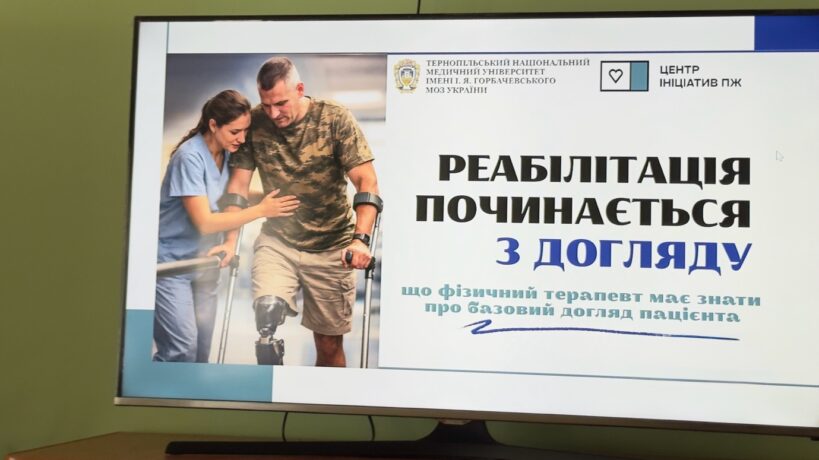
Participants also focused on the principles of DIPPS — dignity, independence, preferences, privacy, and safety. These seemingly simple guidelines shape a different perspective on care, helping professionals see beyond the diagnosis and recognize a person with their own boundaries, fears, and right to choose.
The practical part included an overview of the SSKIN protocol — a key tool in the daily work of a physical therapist. Proper support surfaces, regular skin inspection, continuous movement, moisture control, and adequate hydration form the foundation without which no therapeutic exercises can achieve the desired results. Safe patient transfer techniques and common mistakes to avoid were also discussed in detail.
The atmosphere of the event was warm, focused, and genuinely engaging. Students actively participated in discussions, asked challenging questions, and shared their own observations and experiences. Many admitted that they had not fully realized how significantly basic care affects rehabilitation outcomes.
We sincerely thank the Come Back Alive Initiatives Center, Ivan Franko Homes, and the Lviv Medical Professional College of Postgraduate Education for their valuable knowledge, support, and the opportunity to share practical expertise with future specialists. It is through such meetings that professional responsibility begins — and rehabilitation that truly works takes shape.