

TNMU Showcased the Diversity of Medical Professions at a Lyceum Open Day
On April 26, 2026, I. Horbachevsky Ternopil National Medical University (TNMU) took part in a career guidance event at Lesya Ukrainka Ternopil Educational Complex School-Lyceum No. 15. University faculty and students helped lyceum pupils explore the world of modern medicine and try out various professional roles.
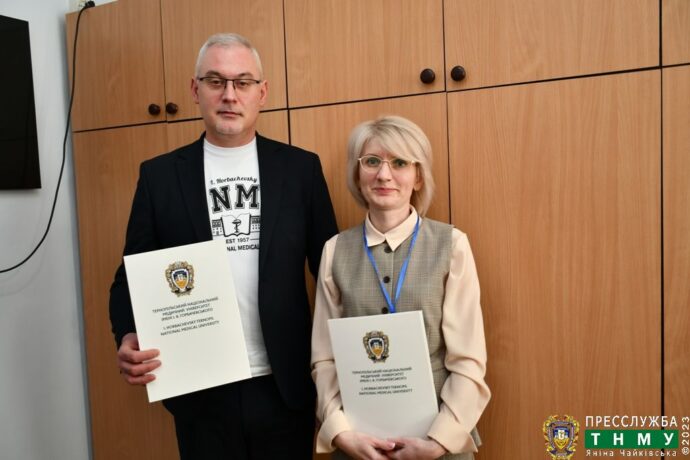
The event was opened by TNMU Rector, Professor Petro Lykhatskyi, and the lyceum director Oksana Mazurenok, who emphasized the importance of close cooperation between secondary and higher education institutions in shaping the future medical elite. On that day, the heads of both institutions signed a memorandum of cooperation.
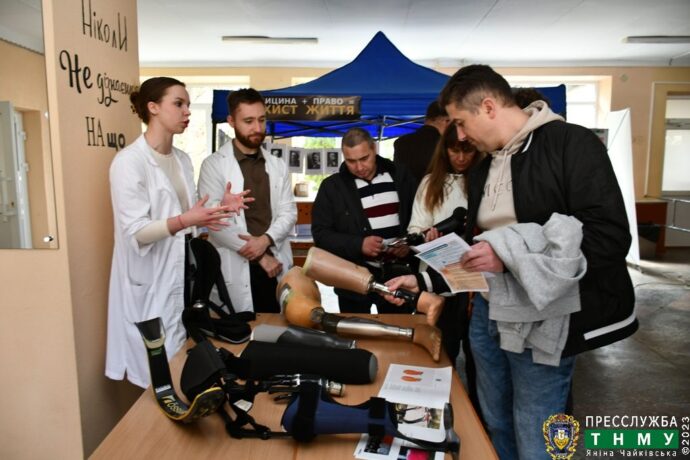
Master’s students of the educational and professional program “Prosthetics and Orthotics,” Anhelina Prasol and Vladyslav Sobetskyi, introduced visitors to modern prosthetic devices and spoke about the importance of the professions of prosthetist and orthotist.
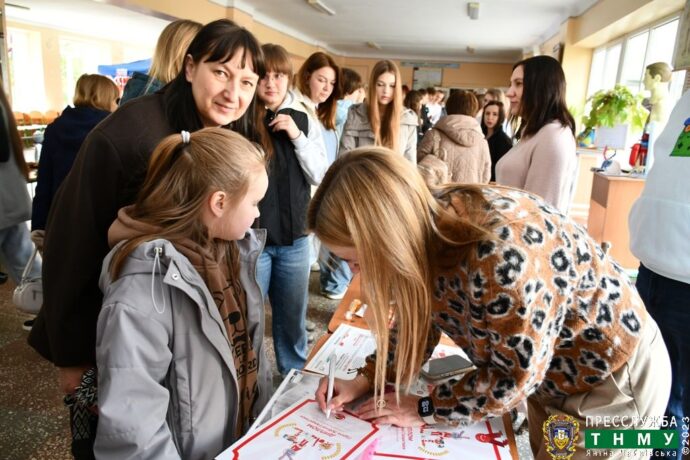
The Faculty of Dentistry, led by Dean Associate Professor Svitlana Boitsaniuk, presented the specifics of the dental profession. Faculty members of the Department of Surgical Dentistry (Iryna Maika, Ivan Stefaniv, Nataliia Tverdokhlib) taught school students proper oral hygiene practices.
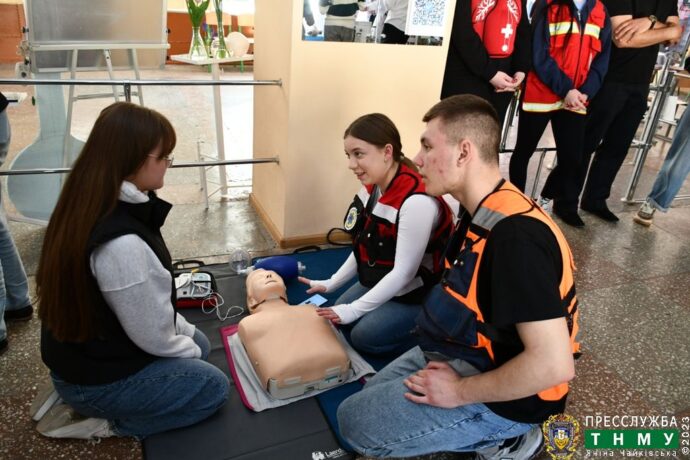
Future paramedics—Ivanna Cherniuk, Yaryna Slivinska, Vitalii Oleshchuk, Iryna Yakovleva, and Daria Kalashnykova—together with Antonina Chervatiuk, Head of the Simulation Training Center, organized a training площадка on the basics of pre-hospital care. Lyceum students and their parents learned how to act in critical situations.
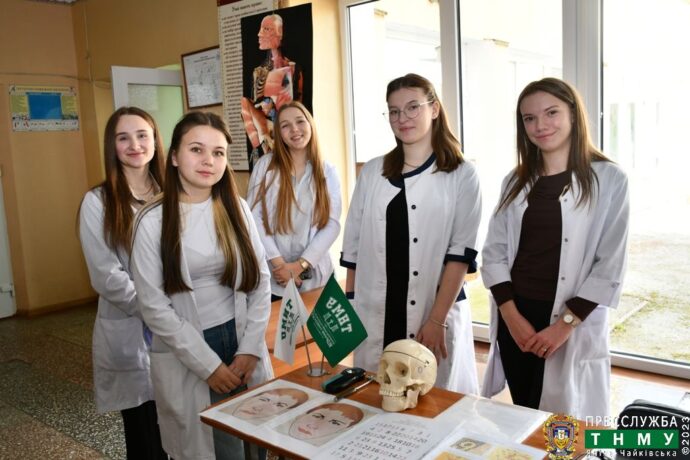
Second-year medical students (group MM-206), Olena Dudkevych, Diana Nazarovets, and Veronika Protsyk, members of the physiology club, introduced school students to practical aspects of medicine. They focused on demonstrating skills: testing reflexes (knee and Achilles), determining cerebral hemisphere dominance using a dynamometer and special test cards, and assessing color vision using Rabkin tables with explanations of their diagnostic value.
They also conducted tests of attention, concentration, and switching, allowing assessment of the functional state of the nervous system. In addition, they measured blood pressure and pulse rate, interpreted the values, and explained their significance for the body.
Representatives of the Student Parliament—Marta Pylypa (group MM-207) and Iryna Rybtsunyk (group MM-212)—checked visual acuity.
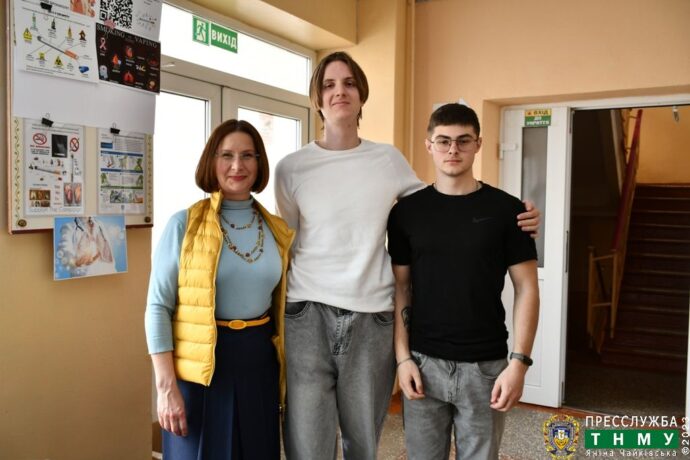
Students of group MM-203, Yurii Bakalets and Maksym Petrivskyi, together with Associate Professor of the Department of Functional and Laboratory Diagnostics, Olena Bakalets, offered lyceum students, their parents, and teachers rapid diagnostic tests to assess the respiratory system’s functional state. Using peak flowmetry (Peak Flow Meter), participants measured peak expiratory flow rate; using pulse oximetry, they assessed arterial oxygen saturation (SpO₂) and pulse rate.
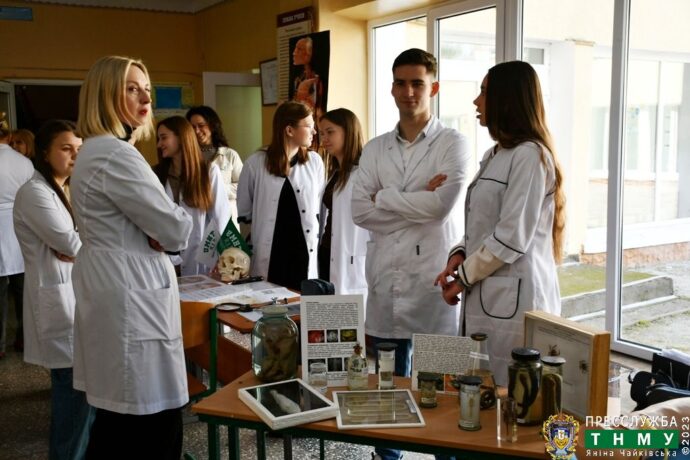
Pryvrotska and third-year medical students Anastasiia Pryvrotska and Nazarii Bobko. It featured models and wet specimens of parasitic worms (echinococcus, tapeworms, roundworms) and venomous animals such as scorpions, spiders, and snakes.
Information about studying in the “Medicine” specialty was provided by the Acting Dean of the Medical Faculty, Svitlana Kucher.
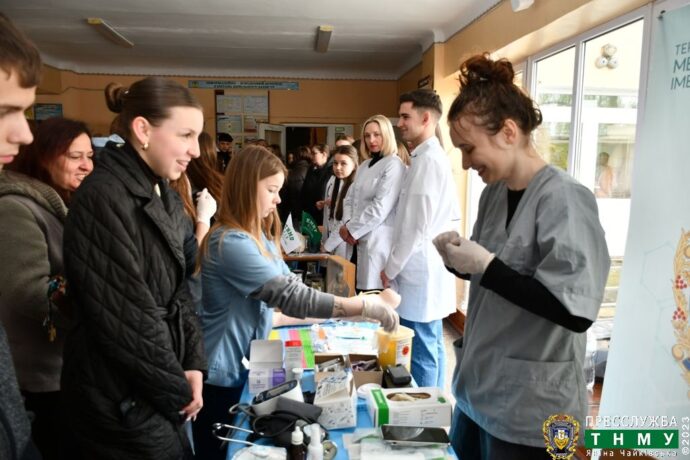
Director of the Educational and Scientific Institute of Nursing, Svitlana Danchak, Assistant of the Department of Higher Nursing Education, Patient Care and Clinical Immunology, Roman Volkov, and students of group MBV-342, Alina Knapyk and Olesia Holodnikova, demonstrated the skills required for the nursing profession.
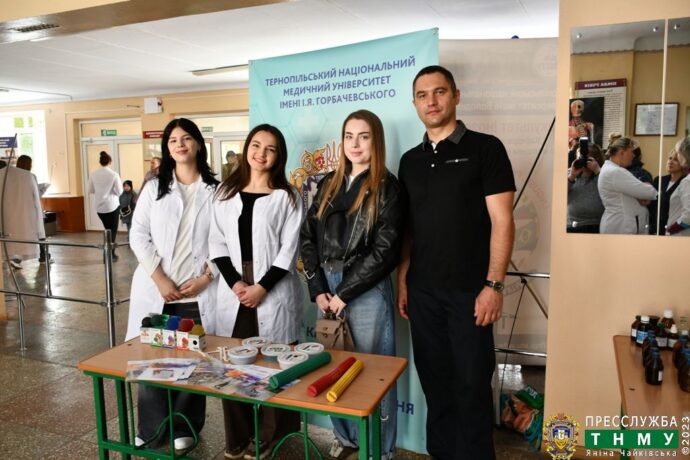
The Department of Physical Rehabilitation, Occupational Therapy, and Physical Education was represented by Associate Professor Viktor Nazaruk, Assistant Olesia Metelska, and students Nataliia Perista and Kateryna Lutsyk. They offered visitors the opportunity to try hand grippers of varying resistance, ball and rubber hand trainers, fine motor skill trainers, and functional rehabilitation equipment. Future physical therapists also presented brochures on measuring anthropometric indicators, proper wheelchair selection, and demonstrated devices such as a goniometer and a scoliometer.
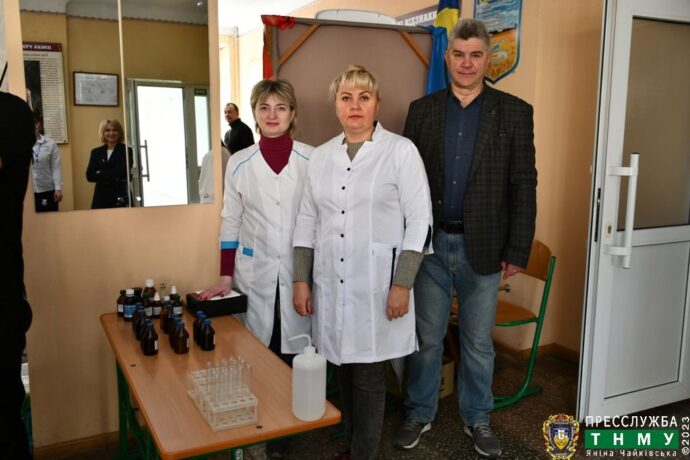
Students were also taught how to conduct chemical experiments by representatives of the Educational and Scientific Institute of Pharmacy—Iryna Ivanusa and Mariia Mykhalkiv—together with the institute’s director, Dmytro Korobko.