


Digi-CHange at the International Cluster Event “Building Resilient Minds for a Digital Future”
On May 13, 2026, the international cluster event “Building Resilient Minds for a Digital Future” brought together three **Erasmus+ projects—UkraineDigiTrans, Digi-CHange, and BURN—around a shared vision of fostering resilient thinking in the context of digital transformation.
The working group of the “Partnerships for Transformation in Higher Education – Digi-CHange” project (Digital Transformation and Curriculum Development for Healthcare Teams), implemented under the Erasmus+ KA2 program, represented I. Horbachevsky Ternopil National Medical University and included Professor Andrii Sverstiuk, Associate Professor Oksana Bahrii-Zaiats, and Associate Professor Andrii Semenets.
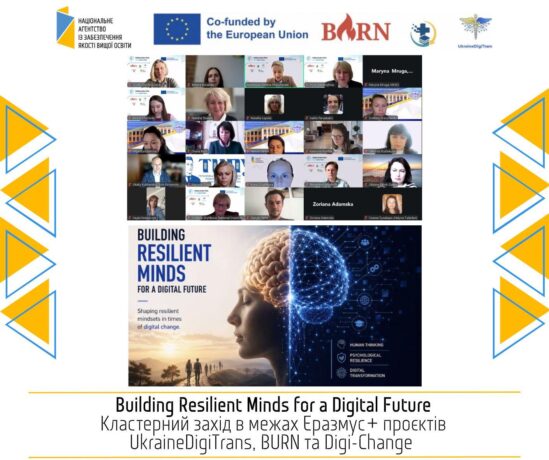
During the event, participants discussed the intersection of digital transformation, human cognition, and psychological resilience as essential components of modern education. Special attention was given to the development of adaptive universities, the enhancement of educators’ digital competencies, and the preservation of critical thinking in the era of algorithms and artificial intelligence.
The first part of the event served as a strategic foundation, highlighting how digitalization and psychological resilience are becoming inseparable elements of contemporary education.
The event was opened by leaders in digital educational transformation:
- Svitlana Shytikova, Coordinator of the National Erasmus+ Office in Ukraine;
- Maryna Mruha, Head of the Expert Group on Integration into the European Higher Education Area (EHEA) and Quality Assurance at the Ministry of Education and Science of Ukraine;
- Nataliia Stukalo, Deputy Head of the National Agency for Higher Education Quality Assurance.
Representatives of the three flagship initiatives presented the core ideas of their projects:
- UkraineDigiTrans focused on the evolution of digitalization and the development of future-oriented educational thinking;
- BURN addressed the design of adaptive universities where psychological resilience is regarded as a strategic advantage;
- Digi-CHange emphasized the importance of preserving human thinking in the age of artificial intelligence and algorithm-driven systems.
These presentations demonstrated how technological advancement and human-centered approaches are becoming the foundation of a new educational reality.
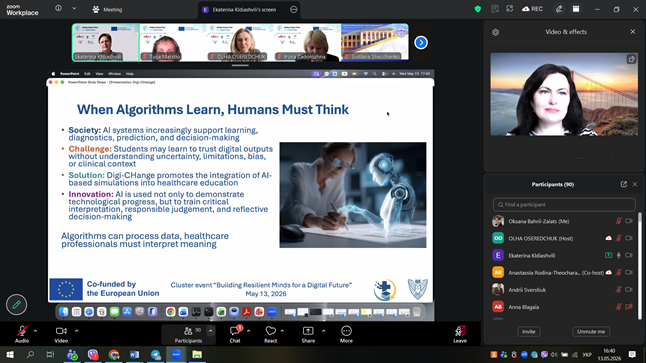
Digi-CHange was presented through the talk “While Algorithms Learn, Human Thinking Still Matters.” The key message of the presentation was that artificial intelligence, digital tools, and simulations should enhance rather than replace human thinking, professional judgment, teamwork, and patient-centered care in medical education.
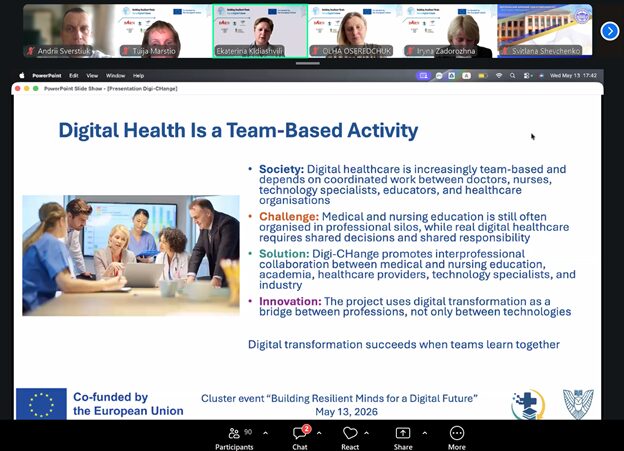
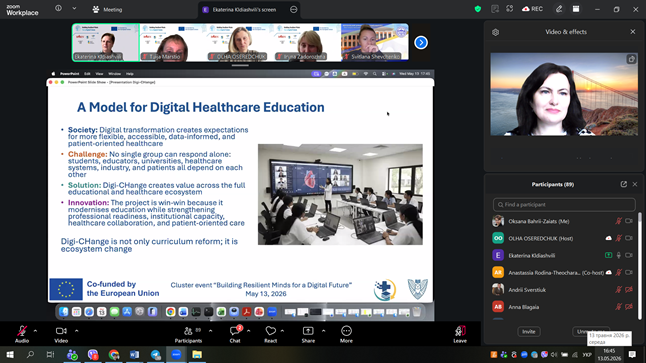
The second part of the cluster event focused on an in-depth analysis of practical experiences and featured an expert panel discussion entitled “Resilience 2.0 and Resilience in Healthcare – Where Are We and What Future Actions Are Needed?”

The invited speakers and panel participants included:
- Ekaterine Kldiashvili, Vice-Rector for Research at Petre Shotadze Tbilisi Medical Academy and coordinator of the Digi-CHange project;
- Kateryna Bondar, Associate Professor at the Department of Practical Psychology, Kryvyi Rih State Pedagogical University;
- Inna Kucherenko, Associate Professor at the Department of Medical and Biological Physics and Informatics, Head of the Educational and Methodological Affairs, Licensing and Accreditation Division at Bohomolets National Medical University, as well as project executor and member of the supervisory board of UkraineDigiTrans;
- Iryna Zadorozhna, Vice-Rector for Research and International Cooperation at Volodymyr Hnatiuk Ternopil National Pedagogical University, along with representatives of European institutions, added an important international dimension to the discussion.
The event provided an important platform for discussing resilience, adaptability, and digital transformation in higher education, while bringing together complementary perspectives from three Erasmus+ projects working toward the future of digital educational technologies.