

Serhii Konoval: “There Are Many Plans, but the Most Important Thing Is to Live to Witness Our Victory”
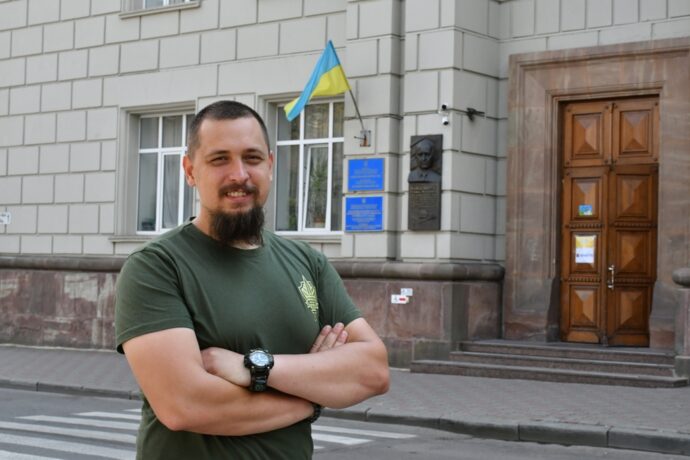
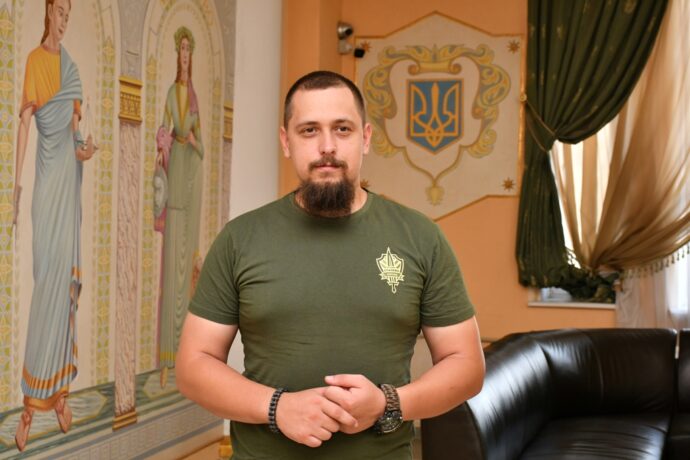
I will always remember the beginning of Russian aggression against Ukraine in 2014, when about a dozen students from Ternopil Medical University traveled to the eastern frontlines of our country during the first months of hostilities to save the lives of soldiers. Among them was Serhii Konoval, who from his student years stood out for his strong patriotism. After graduating from I. Horbachevsky Ternopil National Medical University, he repeatedly conducted tactical medicine trainings for students, and in 2022, from the very first moments of the full-scale invasion, he joined the defense of the country. I had the opportunity to speak with Serhii in August 2023, when he visited TNMU during a break between battles. We publish this interview on his birthday – May 29. Today, Serhii would have turned 34.
— How did your life unfold after graduating from TNMU?
— After university, my life was divided into several categories. One was public activity, which became closely intertwined with the war because it never truly ended. In fact, the war began in 2014 and continues to this day. And then there was work.
— Did your civic engagement begin during your student years?
— Yes, I became actively involved in patriotic activities. The turning point was the Revolution of Dignity, while before that there was simply student life. I was also involved in music. We had our own rock band. After classes, I went to rehearsals, and we often performed. Honestly, my student years were fun and full of music. But all that changed in 2013 when Euromaidan began. I remember watching live broadcasts from Kyiv on YouTube and online. I still remember the footage of students being beaten. They were running from the Berkut forces, but there was nowhere to escape. After that, the Revolution of Dignity began. At that time, I was a third-year student at the Faculty of Dentistry. Together with my classmates, we attended protest rallies near the theater. Later, I traveled to Kyiv to Independence Square, and after that the events in Crimea began. I understood then that this would not end through diplomacy alone. I did not believe any news about diplomatic negotiations. I wanted to be involved in everything that was happening. Since I was studying at a medical university, I wanted to be useful as a medic. I aimed to acquire life-saving knowledge and skills that would be needed in combat conditions.
— At that time, tactical medicine and even first aid were not really taught in Ukraine.
— Exactly. Things like tourniquets, occlusive dressings, and bandages were only beginning to become known to us. I searched within the university for people who could teach us how to use them. At that time, the Department of Military Medicine and Disaster Medicine organized training sessions in “Chervona Kalyna,” and I went there to learn how to provide medical assistance. There I met people from our university who shared views similar to mine. We still keep in touch today. Among them was Mykhailo Denysiuk. Later, we attended military trainings and camps organized by the Right Sector. That was the beginning of a completely different life for me. Soon after, I became a paramedic in a military unit. My first rotation was in Stanytsia Luhanska, then in Pisky. I would return and go back again. In the winter of 2015, I returned to Ternopil and started organizing training sessions in the city to involve more people in drills and military exercises. At that time, I also conducted training sessions for students of our university. I tried to convey the idea that this knowledge and these skills, especially in tactical medicine, should be possessed by everyone.
— Besides training activities, you also had other projects, including the Veterans’ House.
— Yes, that was my idea because there was no place where veterans could gather. Right now, there has been a long pause regarding the Veterans’ House because all the veterans are at war. Only female volunteers remain, gradually continuing this work. Somehow, I will try to restore it so that life is not only about war, but also about opportunities after the war. I also filmed documentaries about the war in order to show people the real situation. In 2018, we organized a cycling trip across America and Canada. We traveled 10,000 kilometers by bicycle. Along the way, we met Ukrainians, Americans, and Canadians. We communicated with them and spoke about the war and Ukraine. We were not fundraising then; we were spreading information about the situation in Ukraine. All these projects consumed my attention, and dentistry gradually moved to the background. Video production became my source of income. In addition to documentaries, I also accepted commercial filming projects.
— Were you preparing for the full-scale invasion?
— We prepared for war extensively. I have friends who intensively prepared a year and a half before the full-scale invasion. We organized press conferences to explain to people that a major war was inevitable. That was in the spring of 2021. We saw Russia actively moving troops toward the Ukrainian border. No one keeps such a large number of troops there for no reason. We trained even harder, prepared our vehicles, gathered everything necessary for tactical medicine, and worked on ensuring communication in case mobile networks failed. We considered different scenarios, including the one that eventually happened.
As soon as it all began, we immediately left for Kyiv. The first combat operations we participated in were in Kyiv and the Kyiv region. I clearly remember February 24, 2022, when at 4 a.m. my commander called and said we needed to leave to defend the country. The highway was heavily congested because people were fleeing in panic. There were huge traffic jams. To reach Kyiv faster, we got out and physically pushed cars aside. People were so terrified that they could not even hear us speaking to them.
— So you and your comrades defended Kyiv?
— First Kyiv, and then the border area between the Chernihiv and Kyiv regions. There is a highway there along which the enemy moved columns of heavy military equipment. Our task was to destroy those logistical routes. It was very dangerous work. Many people were killed there, some were taken prisoner and later murdered. Local residents later showed us where our comrades had been buried. We conducted exhumations. Unfortunately, the bodies had been decapitated. Later, as the enemy retreated, we moved to the Kharkiv region. At that time, Izium had already been occupied by Russian forces. We operated in that area, and later there was Bakhmut. We were stationed in surrounding villages and settlements. The enemy heavily attacked the city and its outskirts. When Soledar was captured, we moved toward Sloviansk. Then back to the Kharkiv region and again to Bakhmut. Now we are carrying out our duties near Kreminna, not far from Debaltseve. This is the border area between the Donetsk and Luhansk regions. It is open steppe terrain, which makes fighting extremely difficult. We are based in a pine forest that often burns due to shelling.
— Do the skills acquired during military training help in real combat?
— Training is extremely important and absolutely worth completing. If first aid skills are well-practiced, many lives can be saved. Training provides a foundation for how to act in combat situations. As a result, there is less fear and more understanding of what needs to be done. In civilian conditions, people can learn a great deal through training and drills. This applies to handling weapons, conducting guerrilla warfare, and many other things. One can also learn navigation, teamwork in large and small groups, and even… digging. Ninety percent of infantry work is digging trenches. That saves lives. If you are poorly entrenched, there is a high chance of being killed immediately. It is important to stay in good physical shape because war is stress. One must endure heavy physical loads under stressful conditions. I advise everyone to take care of their back muscles because body armor, equipment, and weapons are all weight that must be carried constantly. A strong back is important even in civilian life. Overall, every Ukrainian should know how to defend the country because our neighbor is constantly at war with us.
— What or who helps you endure such enormous physical and emotional strain?
— My main support now is my beloved partner. She supports me greatly, both morally and in helping supply our unit. She is an incredibly strong volunteer and makes enormous efforts to ensure that whenever we need something resolved, it is done as quickly as possible. She is the person with whom I always want to talk about pleasant and good things. She is my most reliable rear support.
— Do civilians help?
— Of course. Many of our resources came precisely from civilians, from ordinary citizens. This includes fundraising, purchasing equipment, vehicles, and much more. And that is extremely important. War is like a bottomless barrel — it requires endless resources. Therefore, I ask everyone to help the military so that they receive everything they need on time.
— What are your plans after the war?
— Honestly, the most important thing is to stay alive and live to see our victory. Right now, I have more wishes than plans. I truly want the Veterans’ House to function fully, and I want our youth to grow up in a patriotic spirit. If future generations are not patriots of Ukraine, we will lose our country.