

Vitalii Hakalo: “If You do not See your Patient as Someone Close to You, You Cannot Become a True Doctor”
Last year, during the ceremony honoring the winners of the regional round of the competition for the “Order of St. Panteleimon,” I had the opportunity to speak with our featured guest, Vitalii Hakalo. He was very focused, sincere, and open, while at the same time remarkably mature for his age. And in every word, one could feel his pain for our fallen soldiers and for the losses caused by the war. Today, Vitalii would have turned 25. Let us reflect once again on his words.
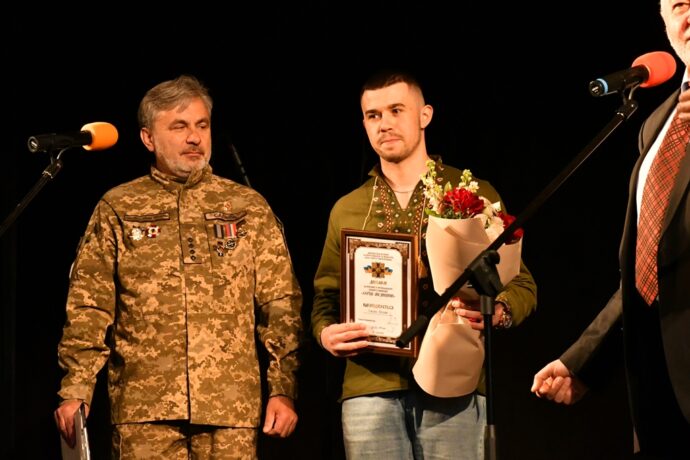
— What is the purpose of your visit to Ternopil today?
— Today I came to the ceremony for the presentation of the Order of St. Panteleimon. Every day, I have a very responsible job, which cannot really be called an ordinary job. Every day is a tremendous responsibility for me. Every patient goes through my heart, because providing medical care in an ordinary, routine way is simply impossible.
If you do not worry about your patient, if you do not see them as a close relative or someone close to you, if you treat them according to the principle, “I don’t know this person, I don’t care,” then you will work accordingly. During the war, every doctor takes this personally and looks at the patient as if they were their own loved one.
You have to do everything you can, provide assistance in order to improve a person’s life or, quite literally, pull a patient back from the brink of death. To do that, you have to put your heart and soul into it.
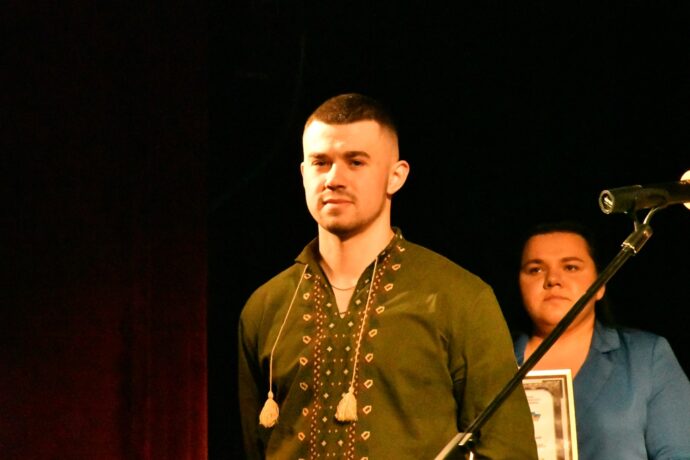
— Your patients are certainly not easy people to work with…
— Most of my patients are people affected by the war. I have been doing this work for many months now. These are our soldiers, our defenders—both men and women—who, by the force of circumstances, took up arms and went to defend our country against Russian occupation and the invaders.
These are special people, because not everyone can pick up a weapon today and risk their life. Everyone wants to live—absolutely everyone. I do not condemn people who do not want to go to war, because there is a direct risk of being killed. But military personnel are people who have taken this responsibility upon themselves. That is why they are especially valuable to us, to Ukraine, and to the Ukrainian nation. Accordingly, these are the people I work with.
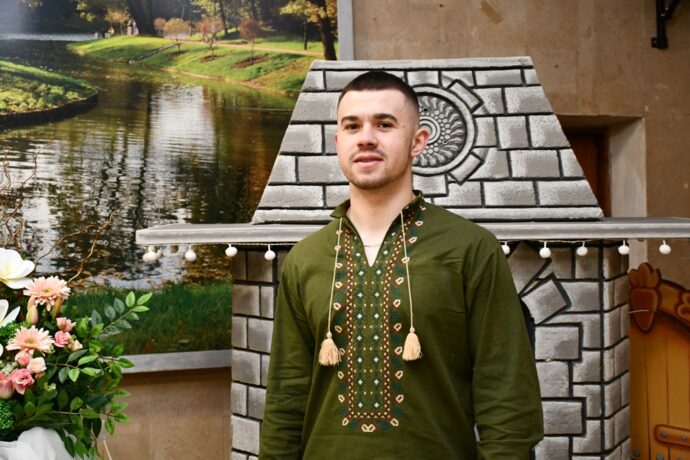
— You joined the effort to save wounded people from the very first days of the full-scale invasion, didn’t you?
— I became involved at the end of 2022, directly on the battlefield. From time to time, I also joined medical teams. Now it is even difficult to count how many rotations and deployments I have had.
For the most part, I joined the work of medics and paramedics in Donetsk and Luhansk regions. I spent one month in Sumy region. And now I am working in the Donetsk direction—Lyman, Pokrovsk…
I was directly in Pokrovsk, and at one point I was in Bakhmut. So, for me, Donbas is like a second home.
— How do you manage to combine your studies with working directly in military conditions?
— Thanks to the doctors who have taught me so much and shared a great deal of their knowledge and experience, I have had the opportunity to gain not only a theoretical foundation.
I was involved in operations that I had not even studied yet. I would take books, prepare theoretically, study descriptions of surgical procedures performed by doctors, and then assist experienced colleagues under their supervision.
So I have a unique opportunity to learn, develop, and hone my skills directly through practice. Even if you do not know something, the doctors will tell you how to do it correctly. The next time, you will sit down, study everything more thoroughly, and then you will be able to do it yourself.
The doctors give me a lot of opportunities to work. I am developing more in traumatology. Of course, I assist during simpler surgical procedures, but traumatology interests me more.
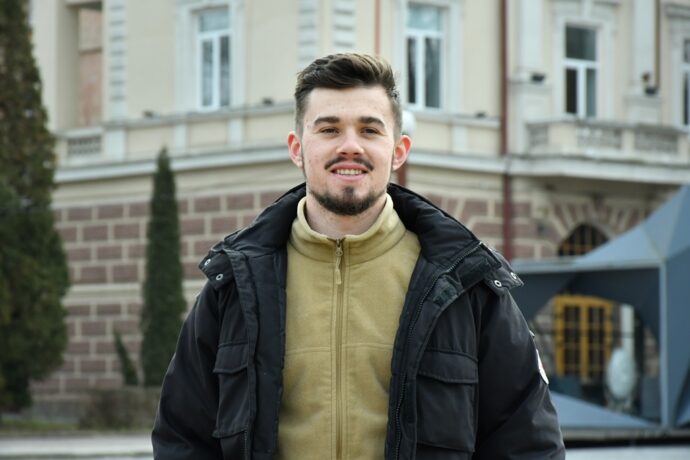
— Have you had an opportunity to meet any of your Ternopil National Medical University lecturers who are also currently fulfilling their duty at the front?
— One of our lecturers at Ternopil National Medical University, Eduard Remeziuk, is directly serving in the Pokrovsk area. He is the head of a surgical department and has had a great influence on me.
We met at the front. I was surprised to discover that he was our lecturer. He strongly supports my professional development. He constantly involves me in surgical procedures.
Other military doctors from the Lviv and Ivano-Frankivsk regions also support me.
— You were the first recipient of the Serhii Konoval Scholarship. What does it mean to you?
— Serhii Konoval was a worthy warrior. As a commander, he was not afraid to go into battle. He fought for his people and for his comrades-in-arms.
He was a representative of the Right Sector. The Right Sector is quite close to me. My brother also serves in the 67th Separate Mechanized Brigade. This brigade is special to me. I worked with it for a long time, and I have many doctor friends there.
For me, it was an honor to receive this award in memory of a person who did so much for our country during his lifetime—and who will continue to do so even after his death.
The example of Serhii Konoval will influence young people and, directly, our university.
— Tell us a little about your journey into medicine.
— I entered the Arsen Richynskyi Kremenets Medical College in 2016. When the medical subjects began, I found studying very interesting. By then, I already knew that I wanted to work in emergency medical care, so I focused on developing in that field.
When I started working, I remembered everything they had taught us. And I realized that it had not been for nothing—that they had been right to make us study so hard.
For me, Kremenets Medical College is a very warm and positive part of my life. I had a wonderful group. Studying there was a pleasure. Whenever I return to Kremenets, I have very pleasant memories of the college.
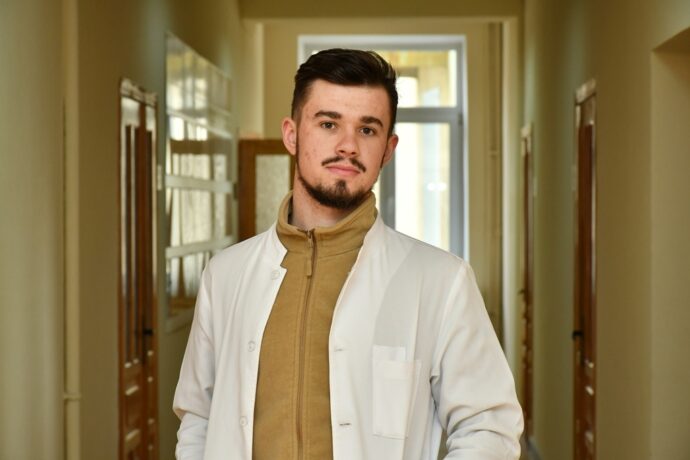
— Do you also enjoy studying at Ternopil National Medical University?
— The university also treats me very well. I have a wonderful group. I have the opportunity to go on rotations. This is a great achievement of the university, because if it were not for the university, I certainly would not be able to do this.
Either I would have had to leave university, or simply study without working. Instead, they gave me the opportunity to combine my studies with my work at the front. I am very grateful for that. Otherwise, I do not know how I would manage.
The university supports me tremendously—the dean and the lecturers alike. They are interested in my development. They help me. I can discuss different cases involving my patients with them.
Many of our lecturers have also served in the war or are currently directly at the front. So I have a lot to talk about with them.
I want all universities to be like ours.
— You often say that you need to make sure you do enough. What do you mean by that?
— Every person has this kind of inner feeling. First of all, when you are doing something and feel that it is not enough, and you see that there is still something you need to do, you feel a sense of emptiness. And you start thinking about how to do more.
It is the same during the war. You see that a great deal of help is actually needed. There are not enough doctors. People are tired and exhausted. And you want to be as useful as possible.
You can also be useful in Ternopil: you can go to a hospital, help doctors with their work, and study. That is also extremely important right now—to be a professional in your field.
But I know that right now I need to be at war, no matter how difficult it is there. Even if I have lost the best years of my studies and my youth, I know that I am useful there.
— What is the value of university education when combined with real-life practice in frontline conditions?
— Many people think that students simply study and that there is no real practical experience at the moment. But I will tell you this: if you do not have theoretical knowledge, at least a basic foundation, it will be difficult to work.
You will be afraid to take responsibility for a patient. Working and learning are easier when there is a doctor—a mentor—next to you. But the moment will come when you have to leave that nest and take responsibility for a patient’s life yourself.
That is difficult. And it is not only about the patient. There are also their relatives and friends. It is not as simple as it may seem. It is genuinely difficult.
If we start thinking, “I don’t need this,” “It doesn’t matter,” “I am an intern,” or “I am learning directly on the job,” nothing good will come of it.
You can learn while working, but it will take time—or it may come at the cost of painful situations in which a patient is lost or harmed.
Everyone knows the medical principle: “First, do no harm.” That is why it is so important to study.
Whenever I have time, I listen to all the lectures again and reread the theoretical materials. You can forget them or stop paying attention to them, but doctors tell me: “You are practicing—that is very good. But if you do not read and do not continue developing, your knowledge will be lost. You will stop knowing anything new.”
Theory is extremely important.
— What are your plans for the future?
— I live in the present. If I need to work today, I work. If I have an opportunity to sleep or study, I do that.
I do not have any grand plans. I do not know what tomorrow will bring.
Today, I do what can help me in my career and benefit the people around me. I do what can help someone.